


Why SaaS architecture is the solution for the future of the product
The architecture of a SaaS platform is not a technical detail or an internal implementation that "the user does not see anyway." In reality, it is the architecture that determines whether the product can:
- withstand user growth;
- evolve without constant rewrites;
- remain stable under high load;
- quickly release new features;
- scale as a business.
In 2026, the architecture of scalable SaaS is the foundation on which the entire product lifecycle is built. Mistakes at the start are rarely noticeable immediately, but almost always manifest within 6–18 months as technical debt, a decline in development speed, and increased costs.
In this article, we will discuss:
- what "scalable architecture" means for SaaS;
- which architectural approaches are used in mature products;
- which mistakes most often hinder growth.

What does "scalable architecture" mean in SaaS
Scalability is not just about increasing servers or users. For SaaS, it is a broader concept.
Scalable architecture allows:
- to serve more users without degrading quality;
- add new features without rewriting the system;
- work with different customer segments;
- support the growth of the development team;
- control technical debt.
Important: the architecture must scale not only technically but also organizationally.
Where SaaS architecture begins
Architecture begins not with the choice of a framework or database, but with the product model.
Key questions at the start:
- multi-tenant or single-tenant;
- which data is isolated between clients;
- which parts of the system will grow the fastest;
- where peak loads are possible;
- which integrations are critical.
Without answers to these questions, the architecture almost always turns out to be "temporary".
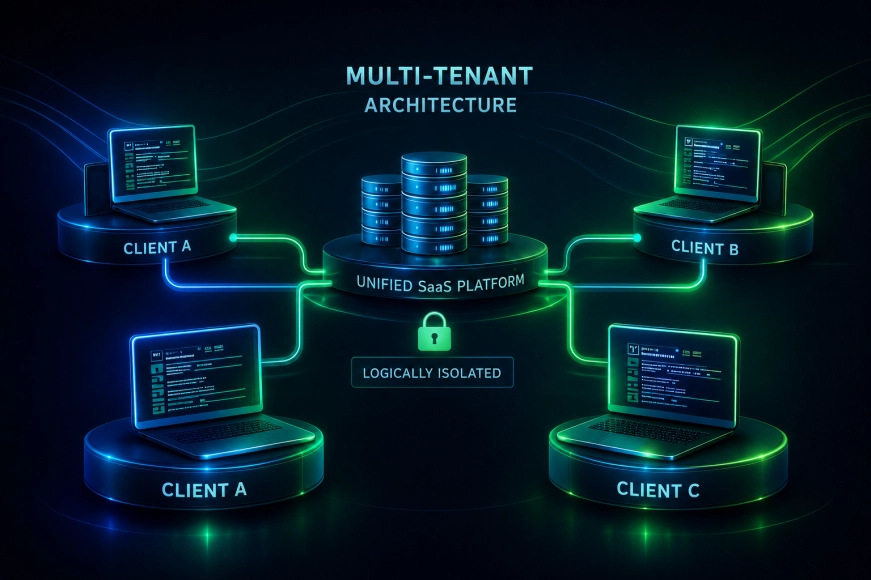
Multi-tenant as the basis for scalable SaaS
Most SaaS platforms in 2026 are built on multi-tenant architecture, where:
- one instance of the system serves multiple clients;
- data is logically isolated;
- updates are applied centrally.
Advantages:
- easier to scale;
- lower support costs;
- faster to release updates;
- single code base.
However, multi-tenant requires thoughtful security architecture and data isolation.
Modularity as the Key to Growth
One of the most common reasons for SaaS degradation is a monolithic structure without clear boundaries.
Scalable architecture is built on the principles of:
- modularity;
- separation of responsibilities;
- loose coupling;
- clear contracts between components.
Modules allow:
- to develop functionality independently;
- to reduce the risks of changes;
- distribute work among teams;
- control technical debt.
Monolith, modular monolith, and microservices
It is important to understand: scalable SaaS is not necessarily microservices.
Possible approaches:
- Classic monolith — suitable only at a very early stage.
- Modular monolith — the optimal option for most SaaS.
- Microservices — justified under high load and large teams.
The choice depends on:
- the product stage;
- the size of the team;
- scalability requirements;
- the complexity of domain logic.
Table 1. Architectural Approaches for SaaS
|
Approach |
When it fits |
|
Monolith |
MVP, early stage |
|
Modular monolith |
Growth and scaling |
|
Microservices |
High load, enterprise |
Working with data and scalability
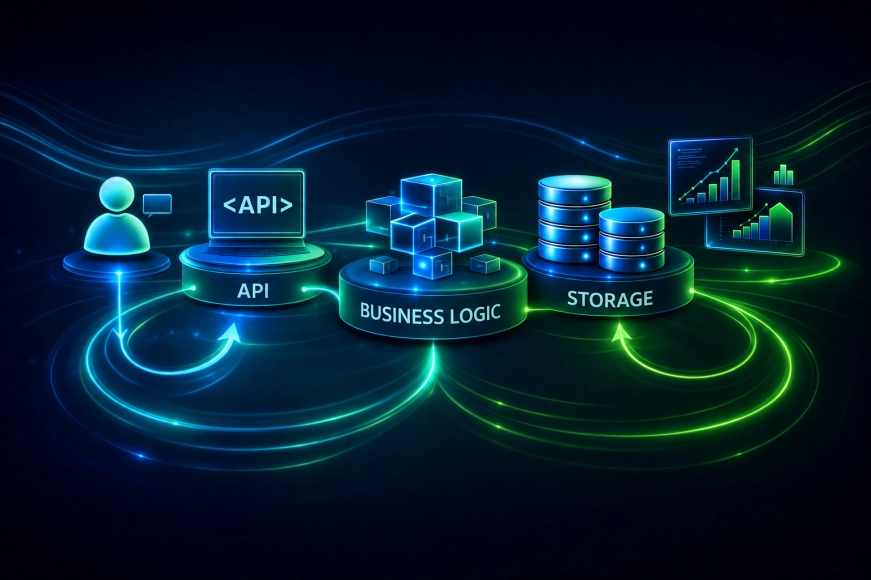
Data — one of the most complex parts of SaaS architecture.
It is important to consider:
- growth of data volume;
- client isolation;
- schema migrations;
- query performance;
- backups.
Errors in the data model almost always lead to:
- performance degradation;
- complex migrations;
- business risks.
Scaling infrastructure
The SaaS architecture must be ready for:
- horizontal scaling;
- failures of individual components;
- peak loads;
- automatic recovery.
Mature SaaS platforms:
- use stateless approaches;
- separate computation and data storage;
- automate deployment and scaling;
- constantly monitor the system's state.
Scalability of infrastructure — a continuation of architectural solutions, not a separate DevOps task.
Security as part of architecture
In SaaS, security cannot be "added later".
Architecturally, the following must be included:
- data isolation;
- access control;
- action auditing;
- API protection;
- secret management.
Security directly affects user trust and the ability to work with corporate clients.

Architecture and speed of product development
One of the key goals of scalable architecture is to not hinder development.
Good architecture:
- accelerates the implementation of new features;
- reduces the number of regressions;
- simplifies testing;
- makes the system predictable.
Poor architecture makes each new release more expensive than the previous one.
Typical mistakes in SaaS architecture
- Architecture "for now", without considering growth
- Early transition to microservices
- Lack of modularity
- Mixing business logic and infrastructure
- Ignoring client isolation
These mistakes are rarely visible immediately, but almost always lead to large-scale rework.
How we approach SaaS architecture design
Our approach is based on the principle: architecture should support product growth, not limit it.
We:
- start with a product model;
- design for scalability;
- choose the appropriate level of complexity;
- build in modularity and isolation;
- think about development for years to come.
The RUSO team views SaaS architecture as a strategic solution, not just a set of technologies.
Conclusions
The architecture of scalable SaaS in 2026 is:
- product and technical strategy;
- basis for sustainable growth;
- tool for managing complexity.
The winning SaaS platforms are those that:
- lay the architecture for growth;
- avoid unnecessary complexity;
- manage technical debt;
- develop systematically, not chaotically.