


Why CI/CD has become essential for mobile development
In 2026, mobile products are evolving in a constantly changing environment: operating system updates, growing user base, new features, bug fixes, and store requirements. In such an environment, manual builds and "holiday releases" stop working.
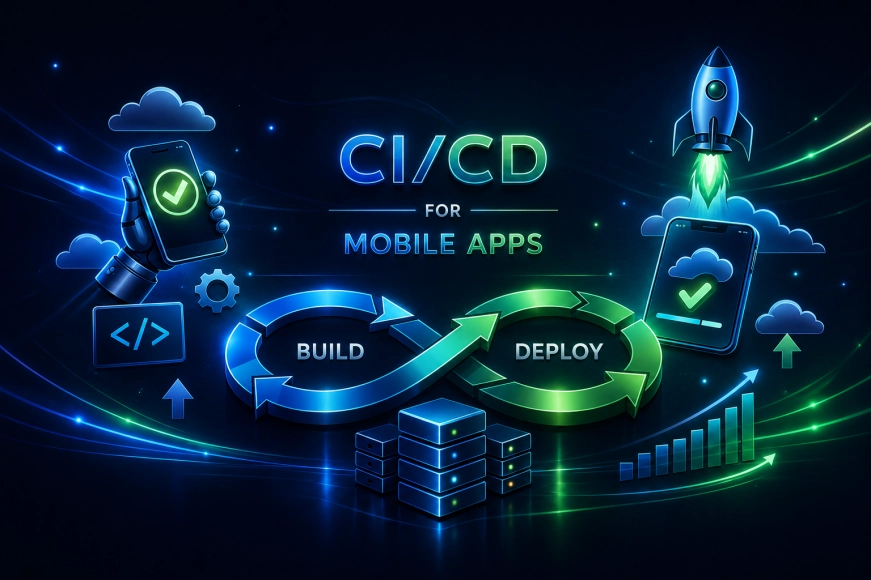
CI/CD (Continuous Integration / Continuous Delivery) for mobile products is no longer a DevOps luxury, but a necessary infrastructure without which it is impossible to:
- quickly release updates;
- maintain product quality;
- reduce the risk of errors;
- scale the development team.
For mobile applications, CI/CD is particularly critical because each release is not just a deployment, but a publication in the App Store and Google Play with strict requirements and delays.
In this article we will cover:
- what CI/CD is in the context of mobile products;
- what tasks it solves;
- how to build CI/CD so that it accelerates development rather than complicating it.
What CI/CD means specifically for mobile applications
In the classical sense, CI/CD is the automation of the processes of building, testing, and delivering code. For mobile products, this concept has its own specifics.
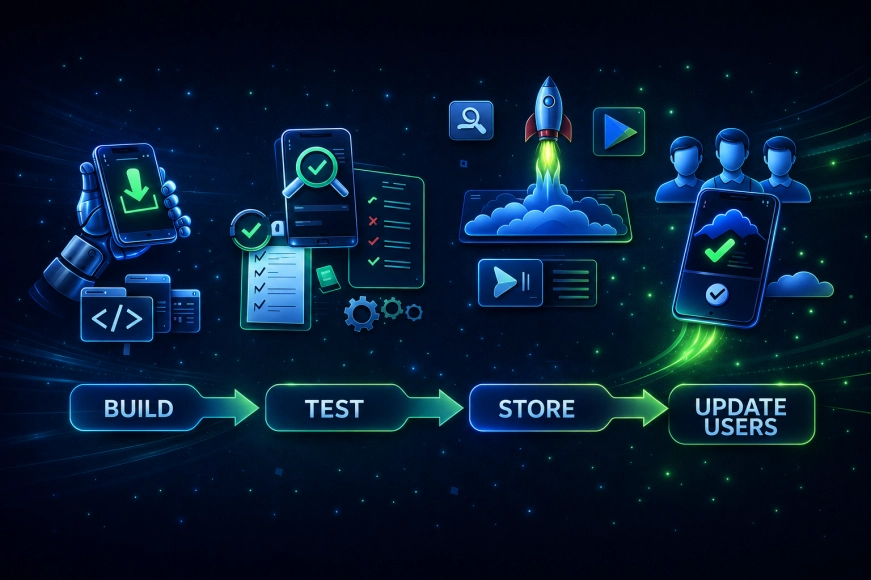
CI/CD for mobile applications includes:
- automatic build for iOS and Android;
- launching autotests;
- code quality checks;
- build signing;
- preparing releases for stores;
- distribution of builds for testing.
It is important to understand: mobile CI/CD — is not a single script, but a set of interconnected processes that take into account the features of the platforms.
What problems does CI/CD solve in mobile products
Without CI/CD, teams face typical problems:
- long and unstable builds;
- «works for me»;
- errors during manual publishing;
- rare and stressful releases;
- high dependency on specific developers.
CI/CD allows:
- to reduce the time between code change and release;
- to decrease the number of human errors;
- to increase the predictability of releases;
- to accelerate feedback for the team.
Continuous Integration: stability every day
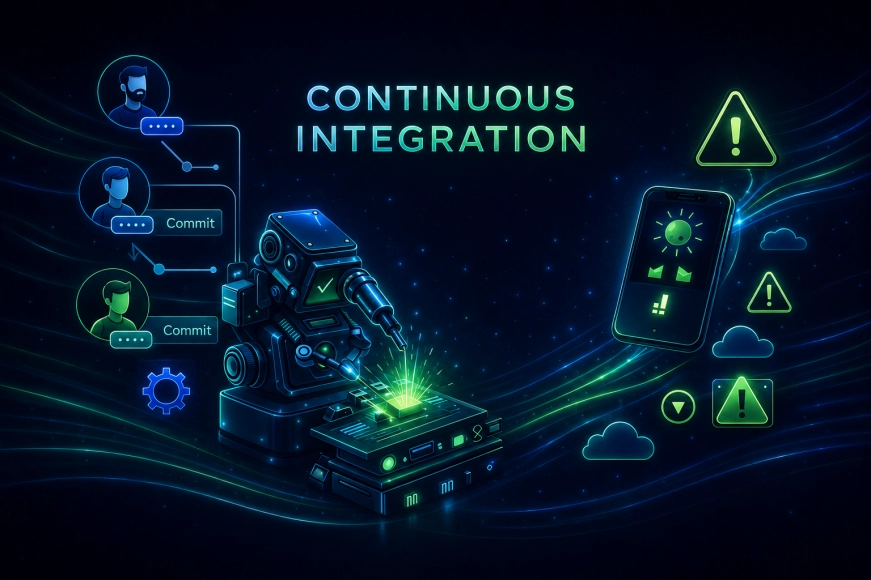
CI starts with automatic code integration.
With every change:
- the code is built automatically;
- it is checked for errors;
- basic tests are conducted;
- issues are identified early.
For mobile applications, this is especially important because:
- the build can "break" due to minor changes;
- different modules affect each other;
- it is easier to fix issues immediately than before a release.
Automated Testing as Part of CI/CD
CI/CD without tests — is just automation of chaos.
In mobile products, the following are most often automated:
- unit tests;
- integration tests;
- UI tests for key scenarios;
- performance checks.
It is important not to try to automate everything at once. It is much more effective to:
- start with critical scenarios;
- gradually expand coverage;
- keep tests up to date.
Table 1. Types of Tests in Mobile CI/CD
|
Type of Tests |
Purpose |
|
Unit |
Logic stability |
|
Integration |
Correctness of interactions |
|
UI tests |
Verification of user scenarios |
|
Smoke tests |
Quick build verification |
Continuous Delivery and releases in stores
In mobile development, CD has its peculiarities:
- mandatory moderation;
- publication delays;
- different requirements for iOS and Android;
- version and build management.
CI/CD allows automating:
- preparation of release builds;
- updating metadata;
- uploading builds to stores;
- distributing test versions via TestFlight and similar services.
This reduces the workload on the team and makes releases more predictable.
CI/CD and Development Speed
One of the main effects of CI/CD — increased speed without loss of quality.
The team receives:
- quick feedback on errors;
- confidence in code stability;
- ability to release updates more frequently;
- fewer "release crunches".
For the product, this means:
- delivering value to users faster;
- quickly fixing issues;
- flexibly responding to the market.
Architecture and CI/CD
CI/CD works effectively only when the product architecture is ready for it.
Key principles:
- modularity;
- independent assemblies;
- minimal dependencies;
- predictable configurations.
Our team in mobile projects always considers CI/CD as part of the product architecture, not as a separate DevOps task.
Table 2. The impact of CI/CD on the product
|
Area |
Effect |
|
Quality |
Fewer bugs |
|
Speed |
Faster releases |
|
Team |
Less stress |
|
Scalability |
Easier growth |
|
Transparency |
Process Control |
Common Mistakes in CI/CD Implementation
- Attempting to automate a chaotic process
- Lack of tests
- Complex and fragile pipelines
- Ignoring platform specifics
- Lack of support and development for CI/CD
CI/CD is a living process that requires attention and evolution.
How to Approach CI/CD Implementation Consciously
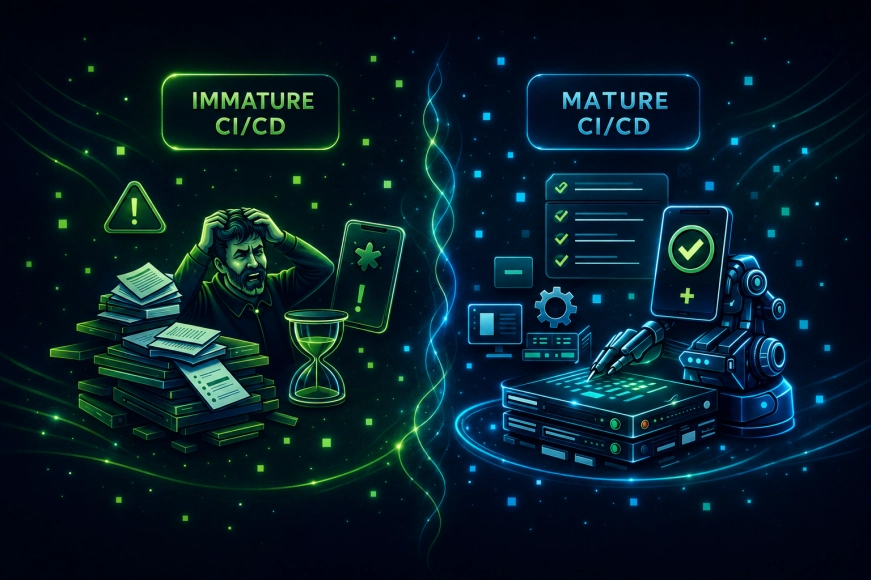
A mature approach includes:
- analysis of the current development process;
- identification of automation points;
- staged implementation of CI/CD;
- team training;
- continuous improvement of pipelines.
CI/CD should make life easier for the team, not become a source of new problems.
Conclusions
CI/CD for mobile products in 2026 is:
- the foundation of stability;
- a development accelerator;
- a risk reduction tool;
- an essential part of a mature product.
Mobile teams that win are those who:
- automate key processes;
- integrate testing into pipelines;
- perceive CI/CD as product infrastructure;
- constantly develop the process.