


Introduction
By 2026, development speed ceased to be a competitive advantage — it became a basic market requirement. Businesses expect rapid releases, flexibility, and scalability, while development teams increasingly work under conditions of parallel streams, distributed specialists, and constantly changing requirements.
In practice, we regularly encounter situations where a project is "slowing down" not due to a lack of resources, but because of architectural constraints. The more complex the system, the more expensive any change becomes — and this is where modular architecture becomes a key tool for accelerating development.
In this article, we will analyze how the RUSO team uses a modular approach, what tasks it solves, where it provides real speed gains, and where it requires engineering maturity.

Why classical architecture can no longer keep pace
Traditional monolithic or loosely structured systems work well at the start. But as the product grows, they begin to resist changes.
Typical problems we see in projects:
- any change triggers a chain of edits;
- it's hard to isolate errors and test individual parts;
- team growth slows down rather than speeds up development;
- technical debt accumulates faster than business functionality.
As a result, the speed of development decreases exponentially — especially after the first 12–18 months of the product's life.

What do we mean by modular architecture
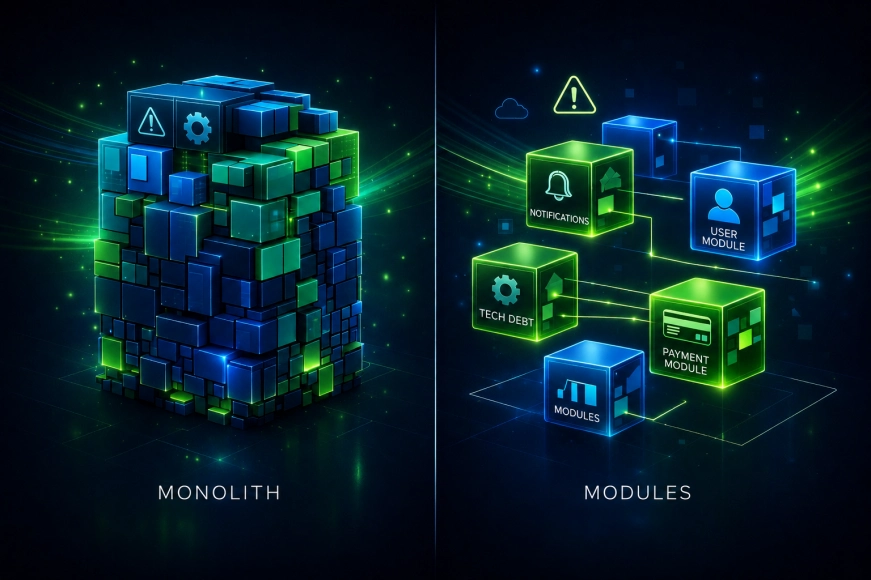
Modular architecture — is not just dividing code into folders or services. It is an approach where the system is designed as a set of autonomous modules, each of which:
- solves a specific business problem;
- has a clear interaction contract;
- minimally depends on other parts of the system;
- can evolve and be tested independently.
Important: modularity — is not necessarily microservices. In practice, we use different levels of modularity — from modular monoliths to distributed systems, depending on the project tasks.
How modular architecture accelerates development in practice
1. Parallel work of teams
When the system is broken down into modules, several teams can work simultaneously without blocking each other. Frontend, backend modules, integrations, analytics — everything develops in parallel.
This is especially critical for projects in an active growth phase.
2. Local changes instead of global edits
In a modular system, changes to business logic most often affect one specific module, rather than the entire codebase. This significantly reduces the time for analysis, implementation, and testing.
3. Faster testing and more stable releases
Isolated modules are easier to cover with tests. Errors are localized faster, and the risk of breaking “something nearby” is significantly lower.
Table: «Comparison of Classical and Modular Architecture»
|
Criterion |
Classical Architecture |
Modular Architecture |
|
Speed of Changes |
Decreases over time |
Stable |
|
Team Scaling |
Complex |
Flexible |
|
Testing |
Comprehensive |
Local |
|
Risk of regressions |
High |
Controlled |
|
Technical debt management |
Reactive |
Proactive |
Technical debt — is inevitable. The question is not whether it will arise, but how manageable it will be.
Modular architecture allows:
- to localize technical debt within specific modules;
- to rewrite parts of the system without complete refactoring;
- to plan the evolution of the product, rather than putting out fires.
In practice, this means that the product can be developed for years without reaching the state of «rewriting everything from scratch».

The Role of AI in Modular Architecture
In 2026, AI became an indispensable tool for development — but only in the hands of experienced engineers. In our practice, AI enhances the modular approach but does not replace architectural solutions.
We use AI for:
- analyzing module connectivity and finding hidden dependencies;
- accelerating the writing of boilerplate code within modules;
- automating tests and contract checks;
- assessing the impact of changes on the system as a whole.
It is important to understand: AI does not design architecture. It helps to work faster with an already properly designed system.
When modular architecture is not suitable
Modularity — is not a panacea. We do not recommend this approach if:
- the product is at the hypothesis stage;
- requirements are unstable and change every week;
- the team is not ready to maintain architectural discipline.
In such cases, we often start with a simplified modular monolith and lay the groundwork for future growth.
How we approach architecture design
The RUSO team does not use template solutions. Before choosing an architecture, we analyze:
- business goals of the product;
- pace of change;
- expected team growth;
- integrations and external dependencies;
- scalability and security requirements.
Only after this do we make a decision — what level of modularity is truly needed for the project.
Conclusions
Modular architecture is an investment in the speed, resilience, and predictability of development. It requires maturity, discipline, and experience, but in the long run, it provides a multiple gain.
In 2026, those who win are not the ones who write code faster, but those who design systems ready for change.