


Why SCRUM is not a set of rituals, but a risk management system
SCRUM is often perceived as a formal set of meetings: stand-ups, planning, demos, retrospectives. However, in real digital projects, such a superficial approach almost always leads to missed deadlines, conflicts between teams, and blurred expectations from the business.
In practice, SCRUM is primarily a tool for managing uncertainty and risks. It is in this context that we use it in our work: as a system that helps the team and the client synchronize, quickly test hypotheses, and control the project's progress at every stage.
Our team views SCRUM not as a dogma, but as a flexible framework that adapts to the product, team, and business context.
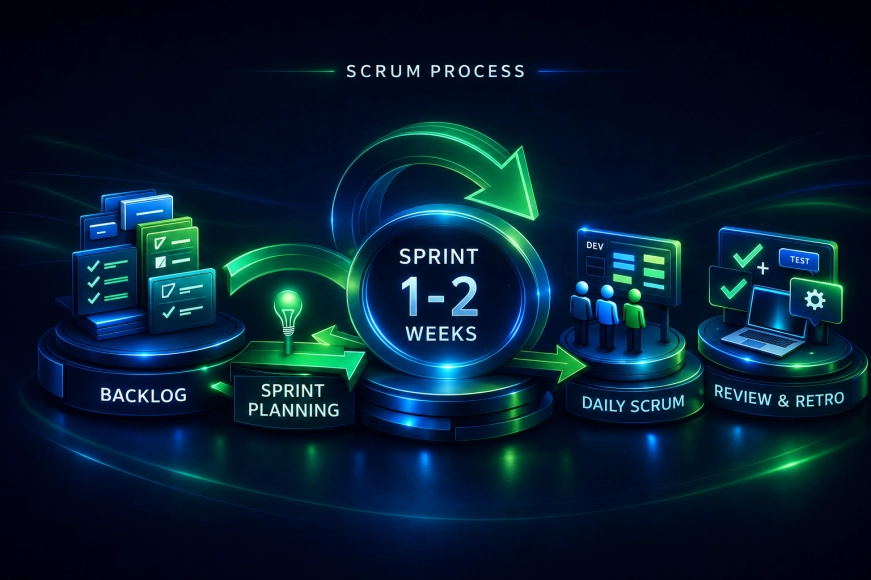
When SCRUM really works
SCRUM is not a universal solution for all projects. It shows maximum effectiveness in situations where:
- requirements can change during the project;
- the product is developed iteratively;
- it is important to receive feedback as early as possible;
- the customer is involved in the process.
In such conditions, classic waterfall management quickly loses control. SCRUM, on the contrary, allows to divide uncertainty into short manageable segments and make decisions based on facts, not assumptions.
How we build the SCRUM process in the project
In the RUSO team, we start not with launching sprints, but with setting up the foundation. Without this, SCRUM turns into chaotic movement without a clear result.
Key steps at the start:
- Form a transparent Product Backlog
- Define roles and areas of responsibility
- Agree on working rules with stakeholders
- Set metrics and expectations for results
SCRUM for us — is not only about speed, but also about predictability.
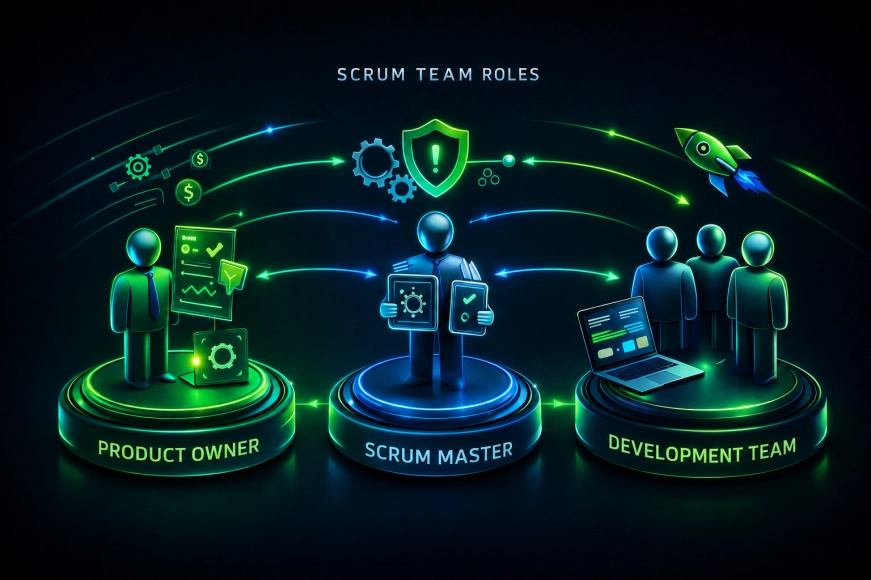
Roles in SCRUM: how we avoid conflicts of responsibility
One of the common problems in SCRUM projects is unclear roles. As a result, tasks "hang," decisions are delayed, and the team loses focus.
We adhere to a clear distribution:
- Product Owner is responsible for the product value and priorities
- SCRUM Master is responsible for the process and removing blockers
- Development Team is responsible for the sprint result
Important: The Product Owner does not manage developers, and the SCRUM Master does not make product decisions. This is fundamental.
Sprint Planning: How We Turn Chaos into a Plan
Sprint planning — the key point of the entire process. Here, a realistic workload is formed, not a "wish list".
We always answer three questions:
- What value do we want to achieve by the end of the sprint?
- What tasks can we realistically complete?
- What risks do we foresee in advance?
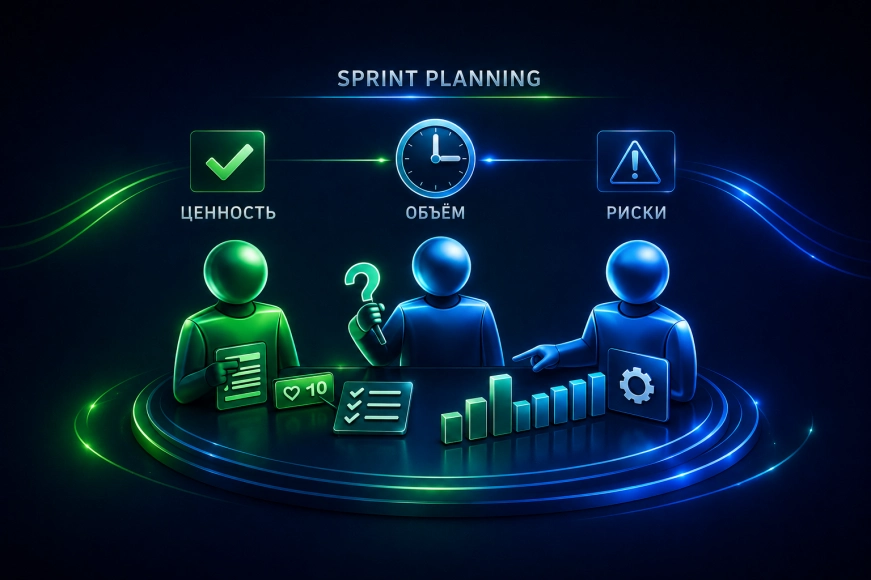
Table 1
Sprint planning: poor vs correct approach
|
Criterion |
Formal Approach |
Our Approach |
|
Sprint Goal |
Vague |
Clear and Measurable |
|
Task Volume |
Maximum |
Realistic |
|
Assessment |
«By eye» |
Based on data |
|
Risks |
Ignored |
Discussed in advance |
Daily stand-ups: not a report, but a synchronization
We use daily stand-ups strictly for their intended purpose. This is not a status meeting for the manager and not a demonstration of busyness.
Stand-up addresses three questions:
- what has been done;
- what is planned;
- what prevents moving forward.
If the meeting does not help identify problems — it is no longer SCRUM, but a simulation of the process.
Working with stakeholders and expectations
SCRUM often "breaks" not within the team, but at the level of communication with the customer. We immediately agree:
- changes are possible, but through the backlog;
- urgent tasks have a cost;
- priorities — not an abstraction, but a choice.
This approach reduces conflict and increases trust.
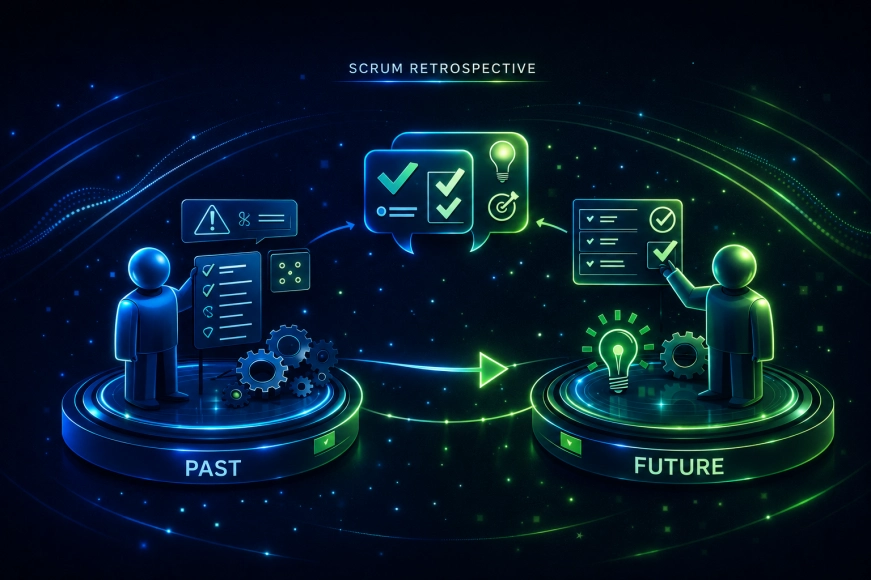
Review and Retrospective: where real improvement happens
SCRUM is often undervalued by skipping review and retrospective. We consider these stages critically important.
- Sprint Review — hypothesis and value check
- Retrospective — working with processes and errors
Without retrospectives, the team does not develop, and problems repeat from sprint to sprint.
Table 2
What regular retrospectives provide
|
Without retro |
With retro |
|
Recurring errors |
Continuous improvement |
|
Accumulation of tension |
Transparent agreements |
|
Loss of motivation |
Increase in engagement |
|
Chaotic process |
Managed process |
SCRUM as a scaling tool
SCRUM scales well if initially set up correctly. We use unified rules, synchronization between teams, and transparent metrics.
It is important to understand: SCRUM — is not a goal, but a means. Its task — to help the business achieve results, and the team — to work effectively.
Conclusions
SCRUM works only when it is used consciously. It is not a set of meetings or a trendy word, but a system for managing uncertainty.
The RUSO team uses SCRUM as a tool:
- risk control,
- increasing transparency,
- accelerating feedback,
- increasing product quality.