


Why SaaS is not just a subscription web application
A SaaS platform is often perceived as a regular web product with authorization and payment. In practice, SaaS is a distinct product and business model, where architecture, UX, billing, scaling, and user support must initially work as a unified system.
In 2026, SaaS platforms compete not only on functionality but also on:
- stability;
- speed of development;
- ease of onboarding;
- transparency of the payment model;
- quality of user experience over the long term.
Therefore, creating a SaaS platform is not about «writing a service», but about designing a digital product with a lifecycle spanning years ahead.
In this article, we will discuss:
- what stages the creation of a SaaS platform consists of;
- what decisions need to be made from the very beginning;
- where critical mistakes are most often made.

Where the creation of a SaaS platform begins
Creating a SaaS never starts with code. The first and most important stage is forming the product hypothesis.
At this stage, it is important to answer the questions:
- what problem the platform solves;
- who exactly it is created for;
- how the user receives value;
- what he is willing to pay for regularly;
- how the product differs from alternatives.
A mistake at this stage almost always leads to the platform technically working, but not growing as a business.
Product Design and SaaS Model
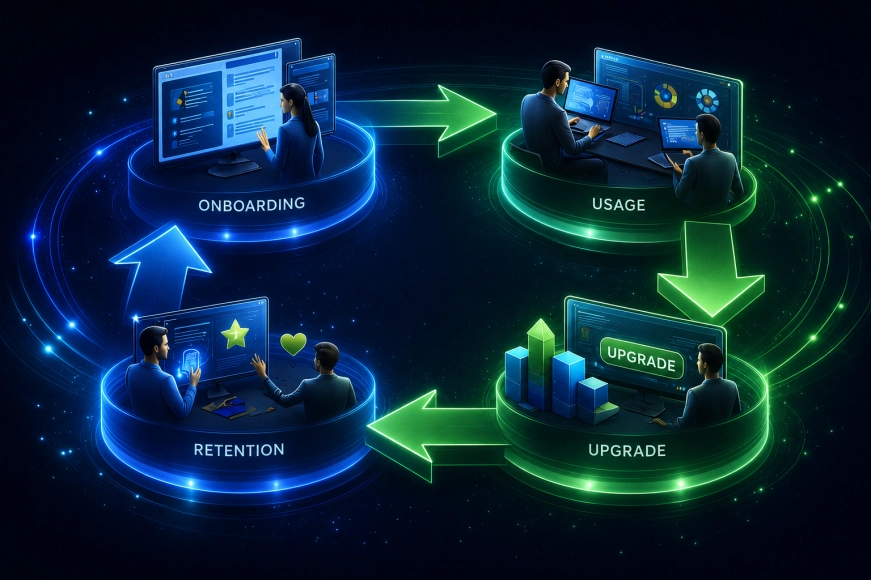
The key difference between SaaS and project solutions is repeatability and scalability.
We always consider:
- user roles;
- use cases;
- interaction frequency;
- entry and exit points;
- retention and churn reasons.
The SaaS platform must be useful not just once, but every day, week, or month.
SaaS Platform Architecture
Architecture is the foundation of any SaaS. Mistakes here can be costly as you scale.
Key requirements for SaaS architecture:
- scalability;
- fault tolerance;
- data security;
- ability for frequent updates;
- client isolation.
It is important to lay out an architecture that can withstand the growth of load, number of users, and functionality.
Multi-tenant or single-tenant: a fundamental choice
One of the key architectural questions is the model of client placement.
Multi-tenant:
- one instance of the system for all clients;
- easier to scale;
- lower support costs.
Single-tenant:
- separate environment for each client;
- greater flexibility;
- higher ownership costs.
The choice depends on:
- type of clients;
- security requirements;
- sales models;
- level of customization.
Table 1. SaaS Architecture Models
|
Criterion |
Multi-tenant |
Single-tenant |
|
Scalability |
High |
Medium |
|
Customization |
Limited |
High |
|
Support cost |
Below |
Above |
|
Security |
Standard |
Enhanced |
|
Update management |
Easier |
Harder |
UX and Onboarding in SaaS
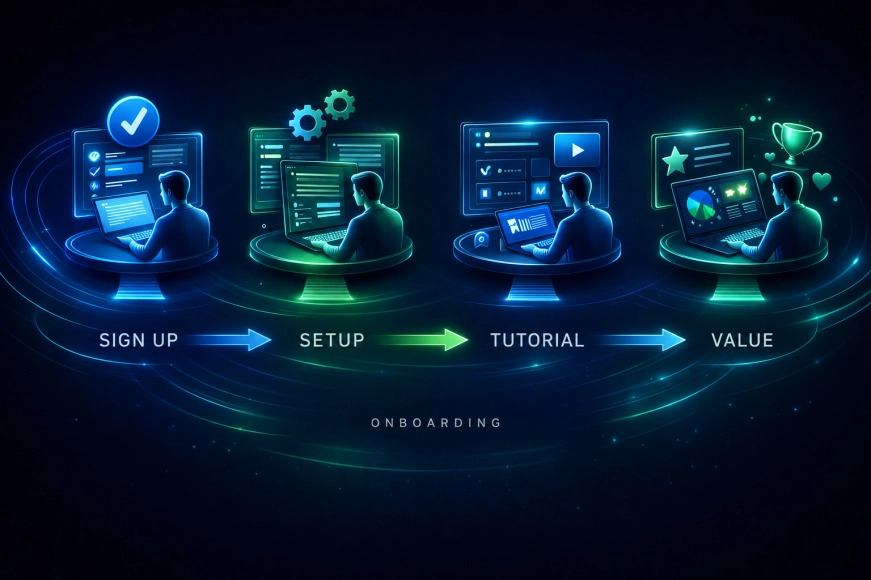
In SaaS, the user does not read instructions — they expect everything to be clear right away.
Key principles of UX:
- quick first result;
- minimal onboarding;
- contextual hints;
- absence of unnecessary steps.
Good SaaS onboarding reduces time-to-value and directly impacts conversion to paying users.
Billing, Tariffs, and Subscriptions
Billing — one of the most underrated and critical elements of SaaS.
It is important to consider:
- tariff plans;
- functionality limitations;
- upgrades and downgrades;
- trial periods;
- handling payments and cancellations.
Billing errors:
- cause distrust;
- complicate support;
- hinder scaling.
Billing must be transparent and predictable for both the user and the business.
Security and Data Handling
A SaaS platform almost always works with sensitive data.
Therefore, security is not an "addition," but a mandatory part of the product:
- access control;
- role delineation;
- data protection;
- activity auditing;
- compliance with legal requirements.
Without trust in security, the SaaS platform will not be able to grow.

Scaling and Support
As the SaaS platform grows, the following increase:
- load;
- number of users;
- support requests;
- stability requirements.
Therefore, it is important to plan ahead:
- establish monitoring;
- automate support;
- have a clear update process;
- manage technical debt.
SaaS is constantly evolving — it is not a project with an end date.
Table 2. Stages of SaaS Platform Growth
|
Stage |
Main Focus |
|
MVP |
Hypothesis Testing |
|
Growth |
Scaling |
|
Maturity |
Optimization |
|
Expansion |
New Markets |
Common Mistakes When Creating SaaS Platforms
- Starting Development Without a Product Hypothesis
- Ignoring billing at the start
- Complex onboarding
- Architecture "for now"
- Underestimating support and scaling
These mistakes are rarely visible immediately, but almost always hinder growth after 6–12 months.
How we approach creating SaaS platforms
Our approach is based on the principle: SaaS is a business product, not just a service.
We:
- starting with product logic;
- designing architecture for growth;
- focusing on UX and onboarding;
- incorporating billing and analytics;
- thinking about support and development in advance.
The RUSO team considers the SaaS platform as a long-term asset, not a one-time launch.
Conclusions
Creating a SaaS platform in 2026 is:
- working with a product model;
- architectural design;
- focus on UX and retention;
- readiness for scaling.
The SaaS products that win are those that:
- solve a real problem;
- provide value from the first minutes;
- are technically and business-logically sustainable;
- develop as a system, not as a set of features.