


Why the team is a key factor in the success of the project
In IT projects, it is common to discuss technologies, timelines, and budgets. However, in practice, it is the team and the distribution of responsibilities that determine whether the project will be manageable and predictable or turn into a constant source of revisions, conflicts, and missed deadlines.
Even with a correct technical specification and sufficient budget, a project can face problems if:
- roles within the team are defined formally;
- responsibility is blurred;
- decisions are made without considering the overall context;
- participants work in isolation from each other.
A mature team is not just a set of specialists, but a structured system of roles, where everyone understands their area of responsibility and the impact of their decisions on the product as a whole.
The team as a system, not a list of positions
One of the key mistakes is to perceive the team as a list of roles: analyst, designer, developer, tester. This approach does not reflect reality.
Results appear:
- at the intersection of analytics and design;
- between design and development;
- between development and testing;
- between the team and the business.
If the interaction between roles is not established, even strong specialists begin to work out of sync. The project loses its integrity, and solutions stop supporting each other.
A quality team — is a system of interconnections, not a linear chain of task transmission.

Analyst: the foundation of project solutions
The role of the analyst is often underestimated, perceived as auxiliary. In practice, it is the analyst who lays the foundation for the future product.
The analyst is responsible for:
- understanding the business goals of the project;
- identifying real user scenarios;
- formulating requirements that can be implemented and maintained;
- resolving contradictions before the start of development.
Errors at the analytics stage almost always manifest later — in the form of constant changes in requirements, redesigns of interfaces, and increased timelines.
Good analytics does not directly speed up the project, but makes it predictable.

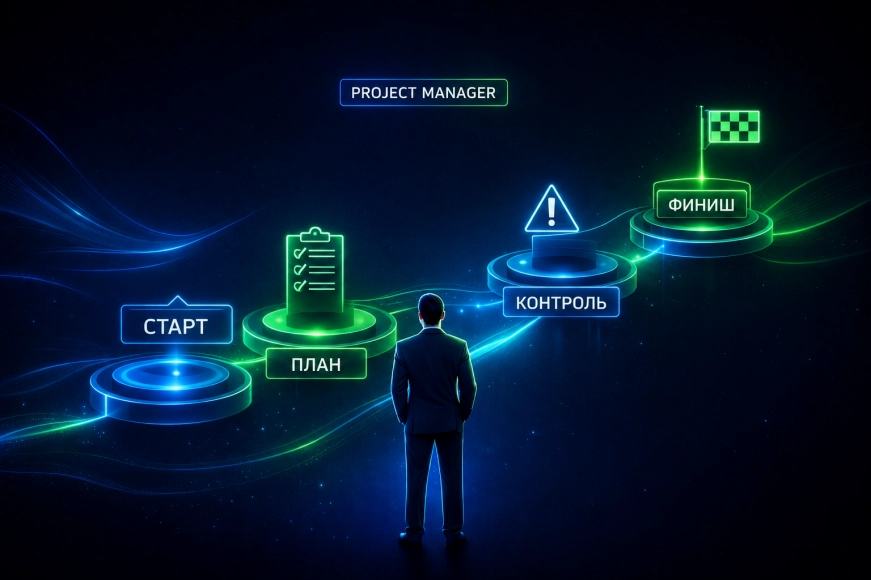
Project Manager: managing the process and risks
The Project Manager is responsible for the overall manageability of the project. Their task is to maintain a balance between timelines, quality, and the expectations of all parties.
The PM's area of responsibility includes:
- planning stages;
- managing timelines and priorities;
- communication between the team and the client;
- fixation of decisions and changes;
- identification and management of risks.
A strong PM allows the team to work in focus. A weak PM, on the contrary, becomes a source of uncertainty and chaos.
UX/UI designer: logic of interaction with the product
A designer in a mature team is responsible not for visual "beauty," but for the logic of user interaction.
His area of responsibility:
- user scenarios;
- interface structure;
- visual hierarchy;
- clarity and predictability of actions.
UX errors rarely seem critical at the start, but over time lead to decreased conversion and complicate product development.
Frontend and Backend Developers: Implementation and Resilience
Developers are responsible not only for implementing requirements but also for what the product will become in the long term.
Frontend Developer is responsible for the user side, performance, and proper interaction with the backend.
Backend Developer is responsible for architecture, business logic, data, integrations, scalability, and fault tolerance.
It is important for developers to participate in discussions of solutions, rather than only getting involved at the implementation stage.

QA: quality control as part of the process
Testing is often perceived as the final stage, but in mature teams, QA is involved in the project from early stages.
QA:
- checks user scenarios;
- identifies logical errors;
- reduces the cost of fixes;
- increases product stability.
Testing — is not about finding bugs for the sake of reporting, but a quality protection tool.
How roles work together
The quality of the project is formed between roles:
- analytics sets the direction;
- the designer shapes the interaction logic;
- development implements solutions;
- QA checks stability.
The team starts to work effectively when all participants see the product as a whole.
Typical mistakes in team work
The most common are:
- blurred responsibility;
- lack of analytics as a stage;
- isolated work of roles;
- testing at the end of the project;
- lack of common understanding of product goals.
These mistakes are almost always organizational rather than technical.
Why the right team reduces risks
Clear role distribution and structured interaction allow:
- to forecast timelines;
- to manage changes;
- to reduce the number of reworks;
- to improve the quality of solutions;
- to create products ready for development.
Conclusions
A mature team is:
- a system of roles;
- transparent responsibility;
- interaction and synchronization;
- product orientation rather than task orientation.
This approach allows for the creation of sustainable digital products and helps avoid chaos in development.