


Why a brand book is not a PDF "for show"
In many IT companies, the brand book exists formally: it is developed once, placed in a folder, and taken out only during a website redesign or merchandise order. In practice, however, the brand book is a working tool that daily influences the quality of communications, brand recognition, and the speed of team work.
In 2026, when IT products are developing rapidly and communication channels are multiplying, the ability to work correctly with the brand book becomes as important a skill as mastering design systems or a component approach in development.

Lifehack #1. The brand book is a system of solutions, not a set of rules
One of the most common mistakes is to perceive the brand book as a list of strict prohibitions: "this is not allowed", "we do not use this color", "the logo must be like this". Such an approach kills flexibility and leads to the brand book being circumvented.
The correct brand book:
- explains why a particular decision is made,
- sets principles, not just forms,
- helps to make new design decisions, rather than limiting them.
If a designer or developer understands the logic of the identity, they will be able to adapt it to new tasks without constant approvals and mistakes.
Life hack #2. Do not store the brand book separately from work tools
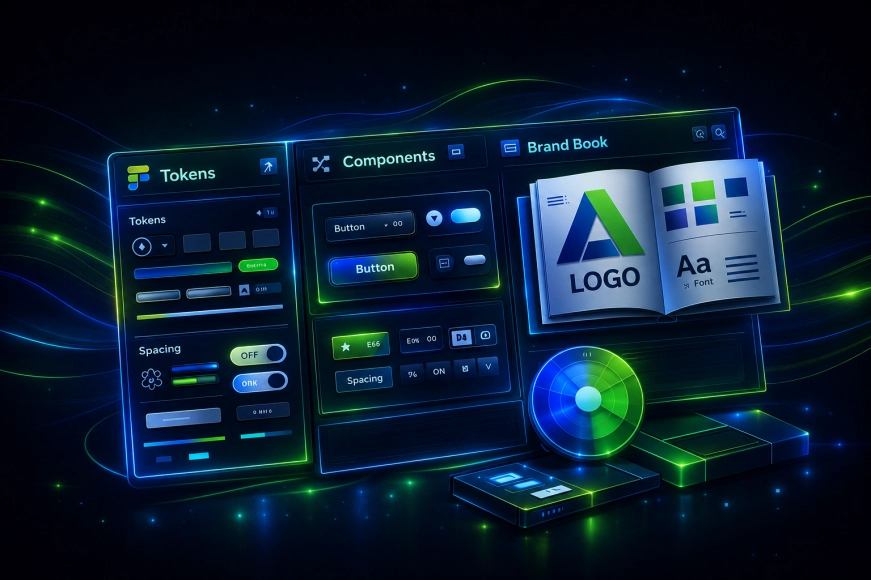
When the brand book exists apart from real processes, it quickly becomes outdated. In modern IT teams, the brand book should be integrated into daily work:
- design tokens — in the design system,
- colors and typography — in UI kits,
- logos and graphics — in a structured asset repository,
- guidelines — available to the entire team, not just designers.
The closer the brand book is to the working environment, the higher the chance that it will actually be used.
Lifehack #3. Separate the "core of the brand" and "flexible elements"
A good brand book always consists of two levels:
Core of the brand (does not change):
- logo and its usage principles,
- basic color palette,
- typography,
- tone of communication.
Flexible elements (can adapt):
- illustrative style,
- patterns,
- animations,
- UI solutions for different products.
This approach is especially important for IT companies with multiple products or directions. It allows for maintaining brand integrity without turning the identity into a rigid template.

Lifehack #4. Make the brand book understandable not only for designers
Often, the brand book is written exclusively "for insiders": complex terms, design jargon, lack of examples. As a result, developers, marketers, and managers either do not read it at all or interpret it in their own way.
A working brand book should:
- be written in simple and clear language,
- contain visual examples of "how to" and "how not to",
- explain the principles of use for different roles.
This is especially important for distributed teams and external contractors.

Lifehack #5. Update the brand book iteratively, not once every 3 years
The identity of an IT company lives and evolves along with its products. The attempt to «fix everything forever» leads to the brand book becoming outdated faster than the website is updated.
The practice that works better:
- regular small updates,
- documenting new solutions as they arise,
- versioning the brand book.
This way, the brand book becomes a living document, not an archive.
Lifehack #6. Check the brand book in real scenarios
Before considering the brand book finished, it is important to test it in practice:
- whether it is possible to create a landing page from it,
- whether it is convenient to use in product interfaces,
- whether it is clear how to adapt the identity to new formats.
If the brand book does not withstand real scenarios, it requires revision.
Table: Common Brand Book Issues and How to Solve Them
|
Issue |
Why it occurs |
How to fix |
|
The brand book is not used |
Complex and abstract |
Simplify and add examples |
|
Common mistakes |
No logic in solutions |
Describe the principles |
|
Conflicts between teams |
Different interpretations |
Unify the rules |
|
Quickly becomes outdated |
No updates |
Conduct iteratively |
Lifehack No. 7. Brand Book — Part of Product Culture
In strong IT companies, the brand book is not just a design document, but part of product thinking. It helps:
- launch new products faster,
- maintain recognition during growth,
- reduce the number of edits and approvals.
When the brand book is perceived as a tool rather than a formality, it starts to work for the business.
Working with the brand book is not about strict limitations, but about managing brand identity in conditions of growth and change. In 2026, the IT companies that win are those that can combine the integrity of identity with flexibility and practicality.