


Introduction: why in 2026 code review is a “booster” and not a “ceremony”
Code review is often perceived as a mandatory ritual: “someone must look at the PR before merging.” In practice, review is one of the cheapest ways to reduce defects in production, maintain architecture within limits, and avoid paying interest on technical debt. Moreover, it can accelerate development if the process is set up correctly.
In 2026, the workload on teams is increasing: releases are more frequent, the stack is more complex, there are more dependencies, and there is less time to “rethink.” Therefore, the code review process stops being just a syntax check. It becomes quality control, architecture discipline, and a risk management element. In projects where code review in the team is organized properly, style aligns faster, there are fewer “hidden” regressions, onboarding is easier, and the cost of changes is lower.
At the same time, code review can easily become a bottleneck: endless nitpicking, discussions with 60 comments, “redo everything,” blockages without agreements, reviews for the sake of reviews. Below are code review rules and specific practices used by the RUSO team that can be scaled to different types of projects.
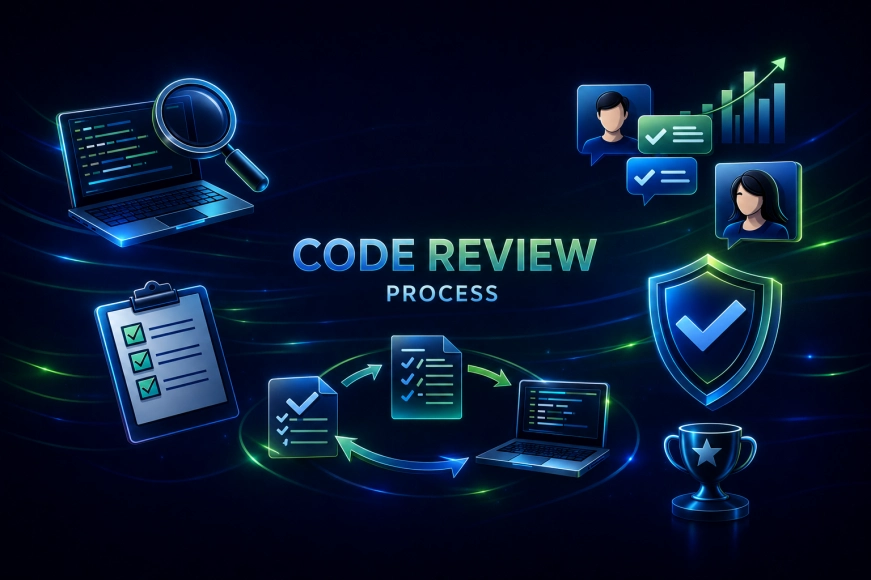
1) What exactly are we trying to solve with code review: goals and boundaries
Before writing a code review checklist, it is important to agree on the purpose of the review. Usually, the goals are:
- Reduction of defects and regressions (logic, edge cases, integration errors).
- Control of readability and maintainability (understandable code is cheaper to maintain).
- Support for architectural principles (boundaries of modules, dependencies, contracts).
- Security and resilience (validation, access rights, secrets, errors).
- Unified Standards (style, naming, project structure).
- Training and Knowledge Sharing (especially important for the growth of mid-levels/juniors).
The boundaries of the review must also be defined, otherwise the process degrades:
- Review — is not a place to “rethink the product” (if the requirements have not changed).
- Review — is not to “rewrite to your taste”, if the code meets the team's standards.
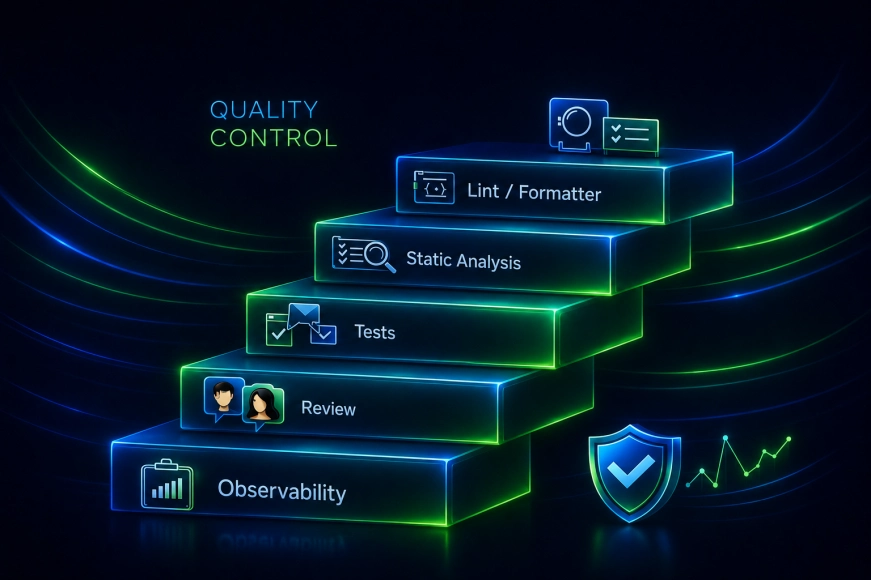
- Review — is not a replacement for tests, linters, and static analysis: these are different levels of control.
Key principle: the review should catch what automated checks do not, and make decisions where context is important (architecture, risks, readability, security).
2) Good PR — half of a successful review: how to prepare changes
In most teams, the main “painful” factor is not the reviewer, but the quality of the original PR. If the PR is too large, lacks context, tests, or structure — the review turns into an investigation.
2.1. Size of PR: “small batches” win
The practice of the RUSO team: keep PRs as small as possible without breaking the meaning. The smaller the PR:
- the less cognitive load,
- the faster the review,
- the lower the chance of missing a defect.
Guideline: not “N lines”, but “one thought”. One PR — one task/hypothesis/change of contract.
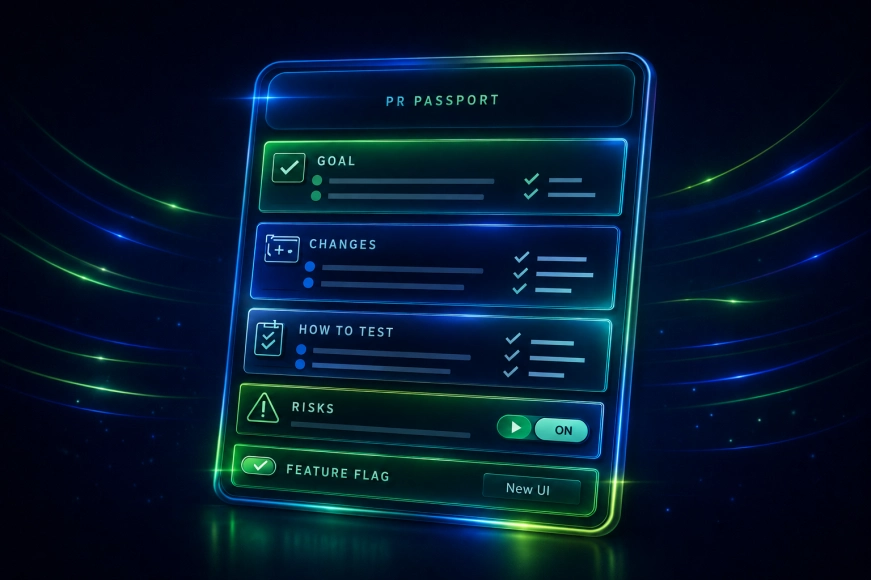
2.2. Description of PR: what must always be included
Minimum:
- what has changed (1–3 points),
- why (context/link to the task),
- how to verify (steps),
- risks (what might break),
- screenshots/videos for UI,
- migrations/flags for backend.
This is a simple step, but it saves hours.
2.3. “Gating” automation before review
What can be checked by a machine — we check with a machine:
- formatter,
- linter,
- typing,
- unit/integration tests,
- migration checks,
- security scan,
- build.
The reviewer should focus on meaning and architecture, not on whitespace and imports.
3) Roles and responsibilities: who, what, and when checks
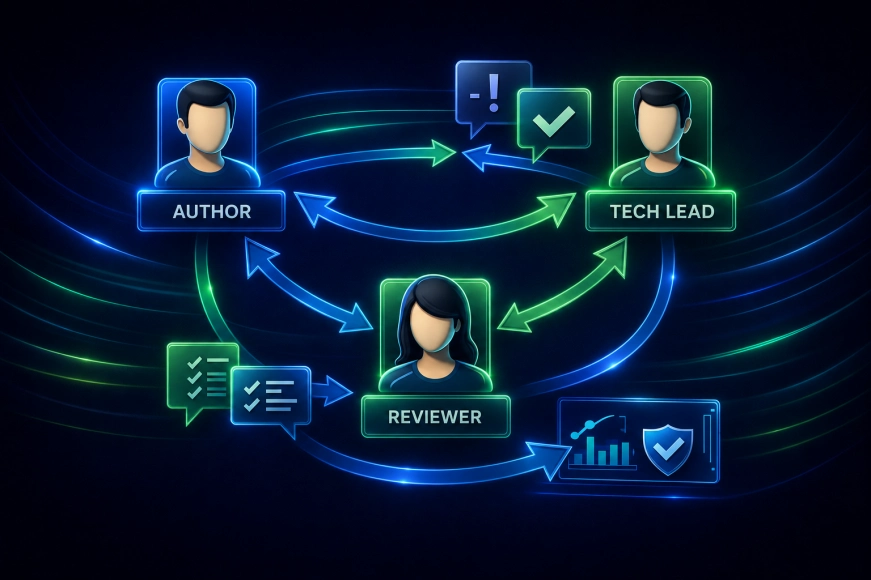
Code review starts to work reliably when roles are clear.
- PR Author is responsible for context, tests, clear description, and readiness for review.
- Reviewer is responsible for the quality of the final decision and risks (not for “perfection”).
- Tech lead/architect (if necessary) — for architectural boundaries and strategic decisions.
- QA/automated tests — for covering scenarios where it is part of the process.
The “two levels” practice:
- Quick review (10–20 minutes): obvious issues, risks, direction.
- Deep review (as needed): critical modules, security, performance.
And one more thing: review — it is a service within the team. It is normal to have an SLA:
- “respond to the review within X hours during working hours”,
- “do not leave PR stagnant”.
This significantly reduces the “downtime” of tasks.
4) Review standards: how to write comments to accelerate, not break motivation
Best practices for code review in the team — it is not only about the code but also about communication.
4.1. Label the type of comment
It greatly speeds up the review:
- Blocker — cannot merge (error, security, regression, contract).
- Suggestion — improvement (readability, style, micro-optimization).
- Question — clarification (why is it so, is there a scenario).
- Nit — minor issue (if the team allows, but do not abuse).
4.2. Critique the solution, not the person
Formulations:
- “At this point, the risk N due to X” instead of “You did it wrong”.
- “I suggest option A because…” instead of “Redo it”.
4.3. Let's “path to the solution”
A remark without suggestions often leads to correspondence. Better to:
- provide an alternative,
- give an example,
- refer to the project standard/guide.
To conduct code reviews consistently across different teams, a checklist is needed. But it should be short and “alive”.
5.1. Logic and correctness
- are edge cases considered,
- are the conditions correct,
- are there no hidden “magic” values,
- are errors handled correctly.
5.2. Architecture and boundaries
- are module dependencies not violated,
- are implementation details not “leaking” out,
- are layers (UI/domain/infrastructure) not mixed,
- are we not creating new technical debt for the sake of speed.
5.3. Testability
- are there tests where the risk is high,
- can it be tested locally,
- has the code been complicated to the point that it cannot be covered.
5.4. Performance and Resources
- N+1 requests,
- unnecessary re-renders,
- heavy operations on the hot path,
- caching.
5.5. Security
- input data validation,
- access rights,
- secret leaks,
- correct handling of PII.
6) Two key decisions that determine the effectiveness of the review
Below are two “bottlenecks” where teams most often lose speed. We will add tables for these blocks.
6.1. What to consider as a “blocker” and what as a “recommendation” (table)
If there is no agreement, everything becomes a blocker — and the review slows down releases.
Table 1. Classification of comments in code review
|
Type of Remark |
When to Apply |
Example |
Status |
|
Blocker (mandatory) |
risk of regression/security/contract |
broken API contract, no error handling, vulnerability |
Merge prohibited |
|
High |
strong risk of support/architecture |
UI layer dependency on DB, increase in technical debt in a critical area |
Usually a blocker by agreement |
|
Medium |
improvement of readability/structure |
long function, unclear names |
Does not block if deadlines are tight |
|
Low / Nit |
cosmetics |
formatting, order of imports (if there is no auto-formatter) |
Does not block |
The position of our team: blocks should only be things that actually increase the risk or cost of changes. Everything else — suggestions that can be moved to technical debt/backlog.
6.2. Review model: “one reviewer” or “pair of reviewers”, and where to involve AI (table)
Currently, teams are increasingly using AI tools as assistants: to highlight potential issues, suggest test cases, check style, find “dangerous” places. But this is not a replacement for an experienced reviewer — especially in architecture and product context.
Table 2. Comparison of Review Models
|
Model |
Pros |
Cons |
Where it fits |
|
1 Reviewer |
Fast, cheap |
Risk of "blind spots" |
typical changes, mature code style |
|
2 reviewers (different roles) |
better at catching architecture/performance/security |
takes longer |
critical modules, public APIs |
|
Review + AI assistant |
accelerates the search for typical issues, helps with tests and style |
can make mistakes without context |
large teams, frequent releases |
|
“Rotation of reviewers” |
even workload, team growth |
quality control needed |
product teams of 6+ people |
RUSO team practice: AI assistant is connected as “the first filter”, and the final decision is up to the person. Especially important: architectural changes and manageability of technical debt cannot be assessed by AI without knowledge of your system.
7) Review metrics: what can really be measured to improve the process
Measurements are needed not for controlling people, but for optimizing the process. Useful metrics:
- Time to first review: how long the PR waits for the first response.
- Time to merge: how long the PR lives from opening to merging.
- PR size: average volume of changes (as an indicator of task breakdown).
- Return rate: how many PRs go for serious rework.
- Defects after merge: bugs related to the changes.
Important: metrics without context are harmful. For example, “merging quickly” can mean “not reviewing well.” Therefore, metrics should be discussed in retrospectives, not turned into KPIs.
8) Typical anti-patterns: how code review breaks (and how to fix it)
- “PR for 2000 lines” → break it down, separate refactoring, set limits.
- “Review as an ego competition” → introduce comment rules, priority labeling.
- “Review only for style” → automate style, leave meaning to people.
- “Merging silently” → minimum standard: description, tests, checklist.
- “Eternal blocks” → SLA for responses, rotation of reviewers, review windows.
Usually, 2–3 agreements are enough for the process to become noticeably more stable.
9) Conclusions: briefly, what to implement in the first week
- Agree on the goals of the review and "what is considered a blocker".
- Introduce a "PR passport" (description + verification steps + risks).
- Automate style/lint/tests before the review.
- Keep PRs small and meaningful.
- Connect the AI assistant as a filter, but not as the final arbiter.
- Start measuring time-to-first-review and time-to-merge.