


Why SaaS monetization is a product, not a financial task
One of the most common mistakes when creating SaaS platforms is to view monetization as a matter of prices and tariffs. In practice, the monetization model is part of product design, which directly affects growth, retention, and the perception of the service's value.
In 2026, SaaS users pay not for functionality as such, but for:
- a solved problem;
- time or money savings;
- predictability of expenses;
- convenience and transparency.
Therefore, a poorly chosen monetization model can "break" even a technically strong product.
In this article, we will discuss:
- the main SaaS monetization models;
- how to choose the right model for the product;
- typical mistakes that hinder growth.
How to Start Choosing a Monetization Model
The choice of monetization model begins not with numbers, but with understanding user value.
Key questions:
- what the user is really willing to pay for;
- how often they receive value;
- what constitutes a "unit of benefit" for them;
- how value changes as usage increases;
- how sensitive it is to price.
If the monetization model does not align with the product usage logic, SaaS begins to lose conversion and retention.
Main SaaS Monetization Models in 2026
1. Subscription
The most common SaaS model.
The user pays:
- monthly or annually;
- for access to the platform;
- for a specific set of features.
Pros:
- predictable income;
- user-friendly;
- ease of scaling.
Cons:
- difficulty in pricing;
- risk of churn with low value;
- pressure for constant product development.
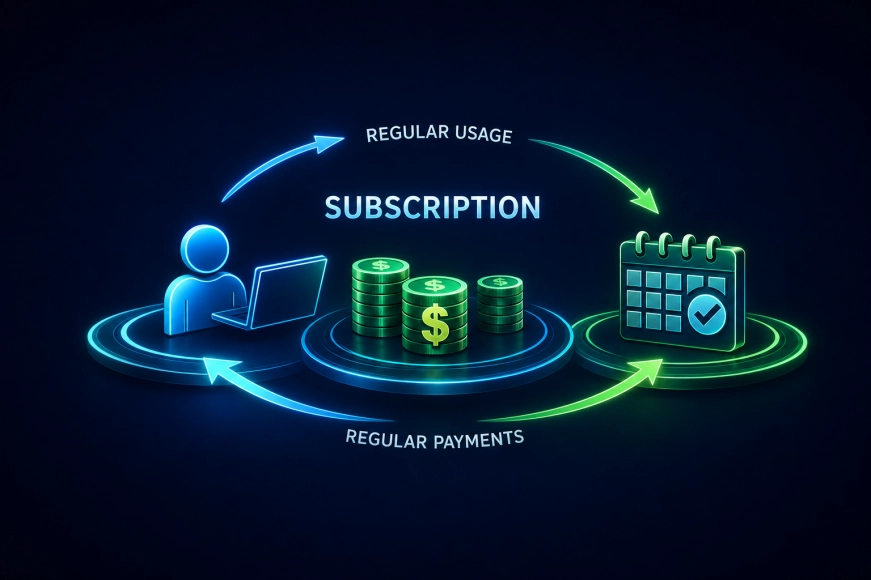
Subscription works best when the product is used regularly.
2. Tiered model (pricing plans)
One of the most popular subscription variations.
The division occurs by:
- functionality;
- number of users;
- data volume;
- level of support.
Important: pricing should reflect value growth, not just a set of limitations.
Table 1. Example of a tiered model
|
Tariff |
For whom |
Main value |
|
Basic |
Individual users |
Basic scenarios |
|
Pro |
Teams |
Collaboration |
|
Enterprise |
Large business |
Scale and security |
3. Usage-based (payment for usage)
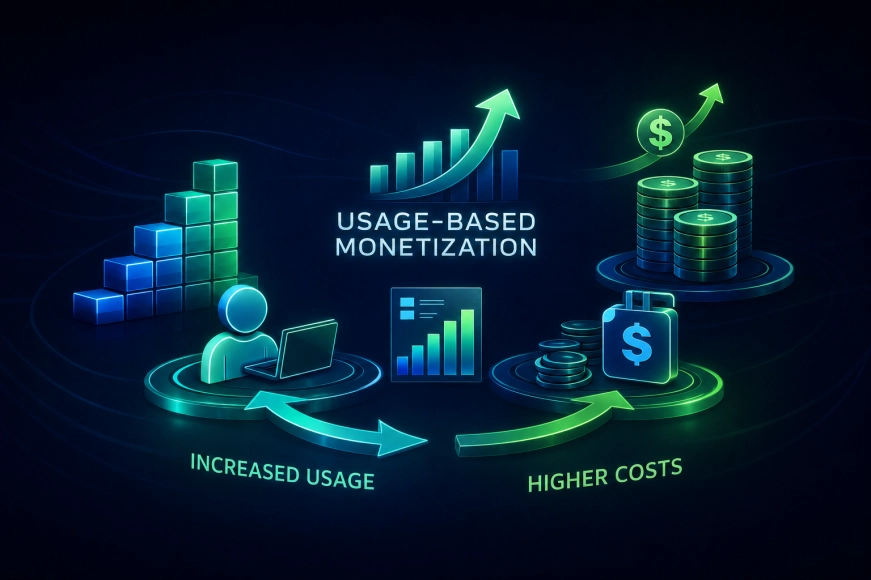
In this model, the user pays:
- for the number of actions;
- for the volume of data;
- for consumed resources.
Advantages:
- fair correlation of price and value;
- low entry threshold;
- good scalability.
Risks:
- difficulty in predicting expenses;
- need for transparent analytics;
- possible fear of "unclear billing".
4. Freemium and trial models
Freemium implies:
- free access with limitations;
- payment for extended features.
Trial — temporary free access to all functionalities.
Both models work well for:
- lowering the entry barrier;
- demonstrating value;
- accelerating onboarding.
Important: the free version should show value, but not completely replace the paid version.
Hybrid monetization models
In 2026, most mature SaaS will use hybrid models:
- subscription + usage-based;
- basic tariff + paid modules;
- freemium + upgrades.
Such models allow:
- to cover different segments;
- to flexibly scale revenue;
- to adapt to client growth.
Table 2. Comparison of Monetization Models
|
Model |
When it is suitable |
|
Subscription |
Regular use |
|
Tiered |
Growth of teams and business |
|
Usage-based |
Variable load |
|
Freemium |
Mass market |
|
Hybrid |
Different segments |
Price ≠ Value: The Key Mistake of SaaS
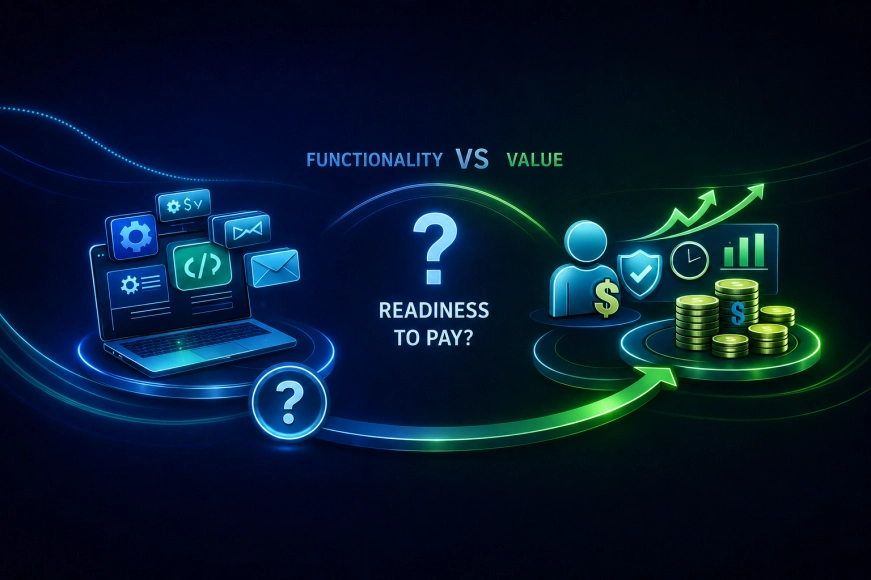
One of the most dangerous mistakes is to tie the price to functionality rather than to value.
It is important for the user:
- what problem it solves;
- how much time it saves;
- what risks it reduces;
- what benefits it provides.
If a product saves a business thousands of dollars, a low price may look suspicious rather than attractive.
Monetization and Retention
In SaaS, monetization is inextricably linked to retention.
Important:
- avoid "price traps";
- do not penalize the user for growth;
- make upgrades a logical continuation of value;
- be transparent about charges and limits.
Monetization should support long-term relationships, not maximize short-term revenue.
Common mistakes in SaaS monetization
- Too complex pricing
- Lack of connection to value
- Opaque limitations
- Early focus on revenue instead of product
- Ignoring analytics and experiments
How we approach SaaS monetization design
Our approach is based on the principle: monetization — is a continuation of user value.
We:
- analyze usage scenarios;
- identify points of maximum value;
- we design tariffs based on client growth;
- we test hypotheses;
- we regularly review the model.
The RUSO team views monetization as a living system that evolves with the product.
Conclusions
The SaaS monetization model in 2026 is:
- part of product design;
- a growth tool, not a limitation;
- a balance between value and revenue.
SaaS products that win are those that:
- honestly link price and benefit;
- provide a clear growth path;
- respect the user;
- adapt monetization to real usage.