


What onboarding in SaaS really is
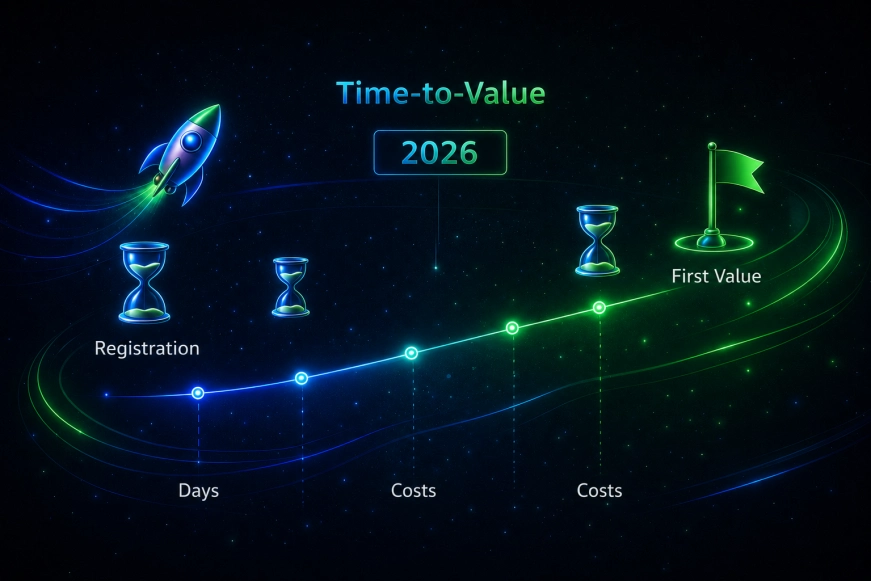
Onboarding — is not a tutorial or a series of hints. It is a guided path for the user from entering the product to the first tangible result (time-to-value).
Good onboarding:
- minimizes frustration;
- explains the product through actions, not text;
- adapts to the user's context;
- helps to quickly achieve the goal.
Important: onboarding does not end when the user has "seen everything", but when they have gained value.
How to start designing onboarding
Onboarding design starts not with screens, but with answers to key questions:
- who our user is;
- what task they want to solve;
- what constitutes their first success;
- what minimal steps are needed to achieve that success.
One of the most common mistakes is trying to show the entire product at once. In SaaS, this almost always leads to overwhelm.
Time-to-Value as a key metric
In 2026, one of the main metrics for onboarding will be time-to-value (time to first value).
The faster the user:
- will see the result;
- will feel the benefit;
- will understand "why this is for him",
the higher the likelihood that he will stay.
Effective onboarding is always aimed at accelerating the first result, not at demonstrating all the capabilities.
Personalization of onboarding
Universal onboarding for all users is becoming less effective.
In 2026, SaaS platforms are increasingly using:
- role-based segmentation;
- adaptation to user goals;
- different scenarios for different types of clients;
- contextual hints.
Example: the administrator and the regular user need different onboarding, even if they work on the same product.
Onboarding formats that work
Effective onboarding is rarely limited to a single format.
Most often, a combination is used:
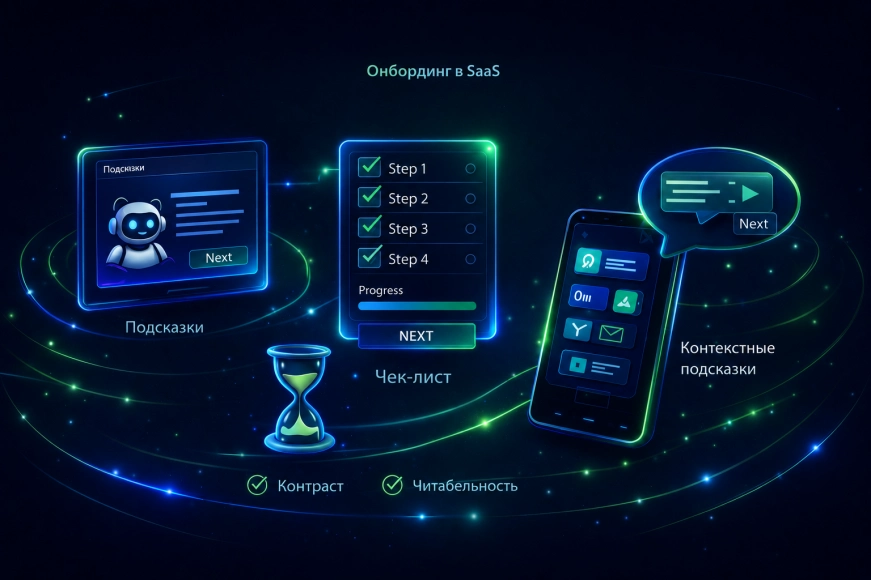
- short interactive steps;
- hints in the context of the interface;
- checklists of first actions;
- progress indicators.
Important: onboarding should guide the user, not distract them from the task.
Onboarding and UX: less text — more actions
One of the key mistakes — trying to explain the product with text.
Working principles:
- explain through actions;
- use micro-copy;
- show the result immediately;
- avoid long instructions.
If a user needs to read to understand how the product works, — the onboarding has already failed.
Common mistakes that break onboarding
- Too much information at the start
- Lack of focus on value
- One-size-fits-all scenario
- Ignoring user context
- Lack of onboarding analytics
These mistakes are rarely visually noticeable, but almost always reflected in the metrics.
Table 1. Onboarding Errors and Consequences
|
Error |
Consequence |
|
Overloaded onboarding |
High churn |
|
No first result |
Low activation |
|
Complex steps |
Rejections |
|
No personalization |
Loss of segments |
Onboarding Analytics
Onboarding cannot be improved without data.
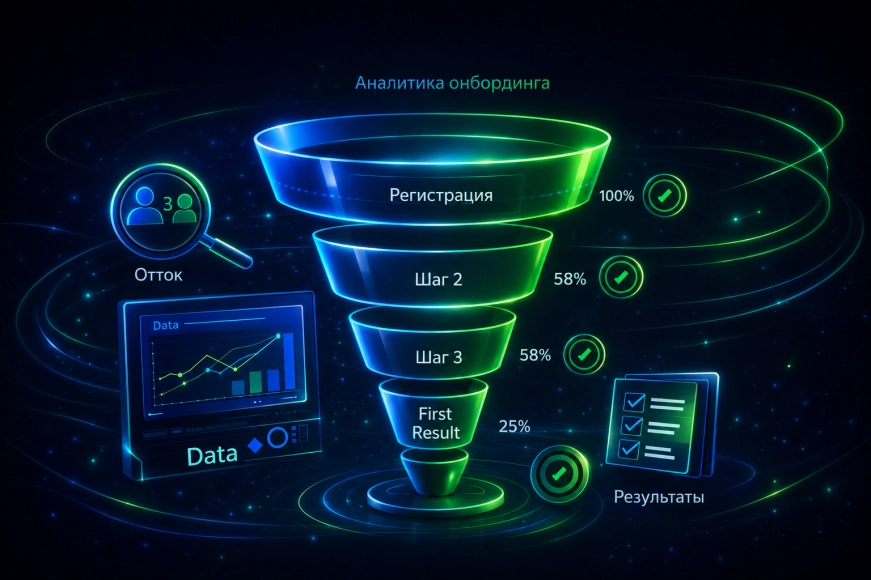
It is important to track:
- where users drop off;
- which steps are skipped;
- how much time is spent on onboarding;
- if they reach the first result.
Mature SaaS views onboarding as a iterative process, not a one-time setup.
Onboarding and Monetization
Onboarding directly affects:
- conversion to payment;
- plan selection;
- willingness to upgrade.
Important:
- do not sell too early;
- first show value;
- it makes sense to lead to paid features.
The best SaaS first helps the user achieve success, and only then offers payment.
How we approach onboarding in SaaS
Our approach is based on the principle: onboarding is part of the product strategy, not a UX decoration.
We:
- start with user goals;
- design the path to the first result;
- use personalization;
- test and improve scenarios;
- rely on analytics.
The RUSO team considers onboarding as one of the key levers for the growth of a SaaS product.
Conclusions
User onboarding in SaaS in 2026 is:
- managing the first experience;
- accelerating time-to-value;
- the basis for retention and monetization.
The SaaS platforms that win are those that:
- help the user quickly gain value;
- do not overload with functionality;
- adapt to different scenarios;
- constantly improve onboarding based on data.