


When microservices stop being a buzzword
In recent years, microservice architecture has become one of the most discussed approaches in the development of complex digital products. However, by 2026, the attitude towards microservices has noticeably changed: they are no longer perceived as a universal solution and are increasingly seen as a engineering compromise that requires maturity, resources, and a clear understanding of goals.
Microservices can indeed provide scalability, flexibility, and team independence. But with the wrong approach, they turn into a source of chaos, rising costs, and technical debt. In this article, we will analyze real cases of transitioning to microservices, common mistakes, and conclusions drawn by mature web development in 2026.
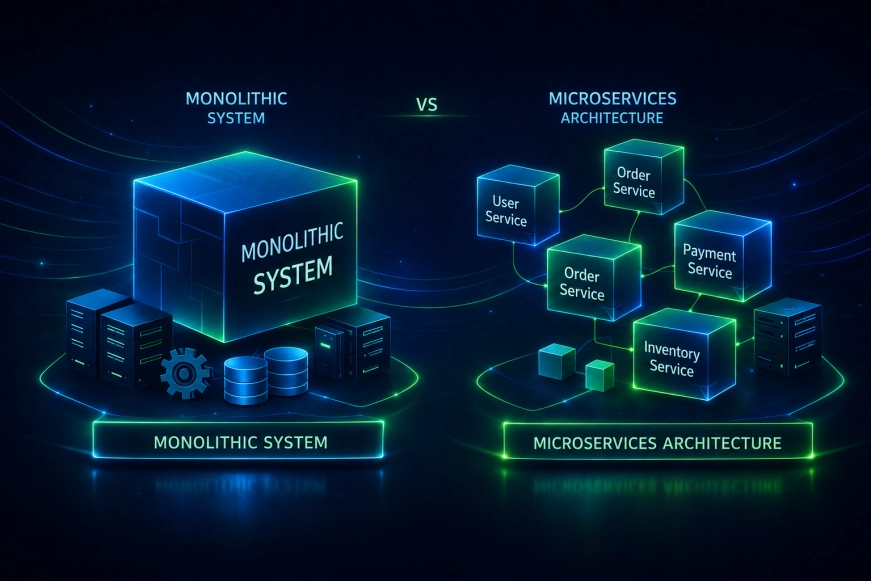
Why companies are considering microservices
The transition to microservice architecture almost never starts «from scratch». In most cases, it is a reaction to accumulated problems:
- slowing down development;
- difficulty of parallel work of teams;
- high risk of changes;
- increased release time;
- complexities in scaling individual parts of the system.
It is important to understand: microservices are not about speeding up the start, but about manageable growth. They only start to bring benefits when the product has already reached a certain level of complexity.
Case 1. Product Growth and Monolith Breakdown
One typical scenario is a mature product that started life as a classic monolith. Over time:
- the codebase expands;
- business logic intertwines;
- any change requires a full regression.
In such a case, the transition to microservices most often begins with isolating the most loaded or frequently changed domains: authorization, billing, catalog, analytics.
Key takeaway:
Microservices are effective when isolated by business domains, not by technical layers.

Case 2. Scaling teams, not systems
In many projects, the reason for the transition is not technical but organizational factors. When 3–5 or more teams start working on a product, the monolith becomes a bottleneck.
Microservices allow:
- to distribute responsibility;
- to release changes independently;
- to reduce the number of conflicts during development.
However, without mature DevOps processes and architectural control, such a scheme quickly leads to desynchronization of services.
The cost of microservices: what is often underestimated
Transitioning to a microservices architecture almost always increases operational complexity. This concerns:
- infrastructure;
- monitoring;
- logging;
- network interactions;
- security;
- support.
Table 1. Monolith vs Microservices: Practical Comparison
|
Criterion |
Monolith |
Microservices |
|
Project Launch |
Fast |
Complex |
|
Scaling |
Limited |
Flexible |
|
Team Management |
Difficult |
Independent |
|
Infrastructure |
Simple |
Complex |
|
Errors |
Localized |
Distributed |
|
Support cost |
Below |
Above |
Case 3. Premature transition and its consequences
One of the most common anti-cases is the implementation of microservices at an early stage of the product. This usually leads to:
- increased development time;
- complexity of deployment;
- increased number of errors;
- loss of system transparency.
In such cases, microservices do not solve the problem, but exacerbate it.
Conclusion:
If the product does not yet experience real limitations of a monolith, microservices are redundant.

Microservices and Technical Debt
In 2026, microservices are seen not as a protection against technical debt, but as its accelerator in the absence of discipline. Without:
- API contracts,
- documentation,
- versioning,
- a unified approach to logging,
microservice architecture is quickly becoming difficult to manage.
Table 2. How microservices affect technical debt
|
Team maturity level |
Effect of Microservices |
|
Low |
Sharp Increase in Technical Debt |
|
Medium |
Local Improvements |
|
High |
Controlled Evolution |
Role of Architecture and DevOps
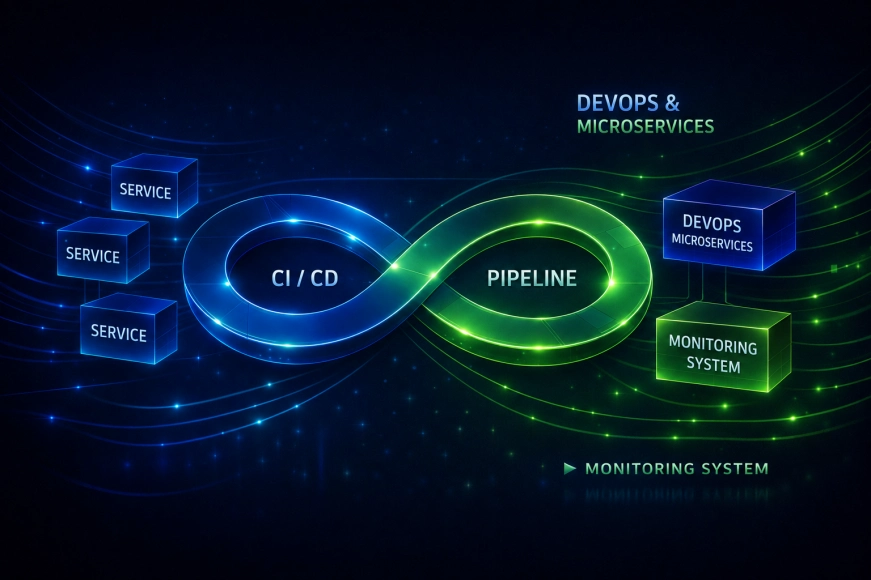
Microservices are impossible without mature DevOps practices. CI/CD, monitoring, alerting, request tracing — are not options, but a mandatory foundation.
Moreover, the architecture must develop centrally, even if the services themselves are developed in a distributed manner. In our practice (including projects of the RUSO team), the lack of architectural control becomes the main reason for the failures of microservices initiatives.
Conclusions: when microservices are truly justified
Transitioning to microservices makes sense if:
- the product is complex and actively evolving;
- multiple teams are working on it;
- there are mature DevOps processes;
- the architecture is viewed as a strategic asset.
In all other cases, a more rational solution remains the modular monolith or hybrid approach.
Conclusion
Microservices in 2026 are not a goal, but a tool. They do not make the product better by themselves, but when applied correctly, they allow teams to scale, reduce change risks, and manage complexity.
The main takeaway from real cases is that architecture should match the product stage, not market trends.