


Why does a product need a roadmap instead of just a task list
In most IT projects, the problem is not a lack of ideas or tasks, but a lack of a common direction. Teams are doing something, features are being added, designs are being updated, but the product is developing in a fragmented way. This is where the need for a product roadmap arises.
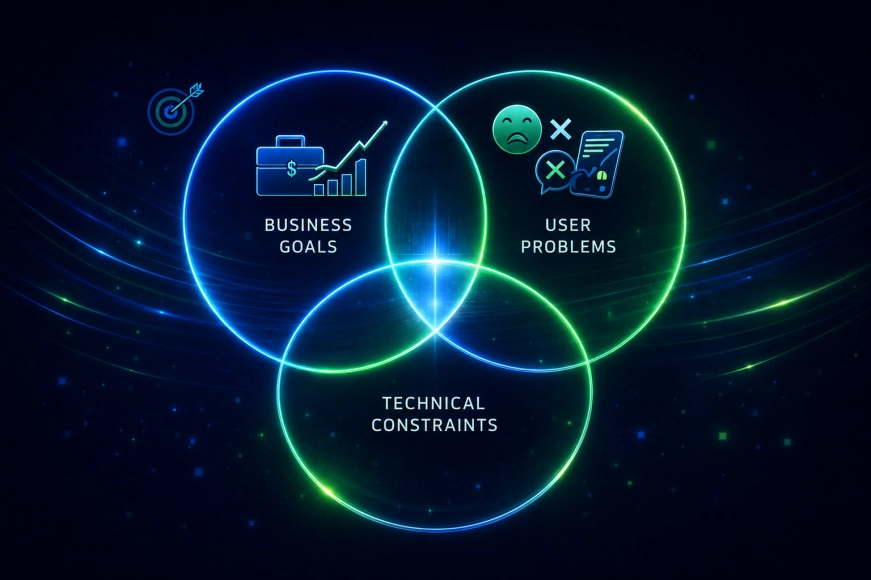
A product roadmap is not a detailed development plan or a backlog. It is a strategic tool that shows where the product is heading, why, and in what order. It connects business goals, user value, and technical constraints into a unified decision-making system.
Without a roadmap, a product can easily turn into a set of unrelated improvements that are difficult to explain to the client, the team, and even to oneself after six months of work.
What is a product roadmap in practice
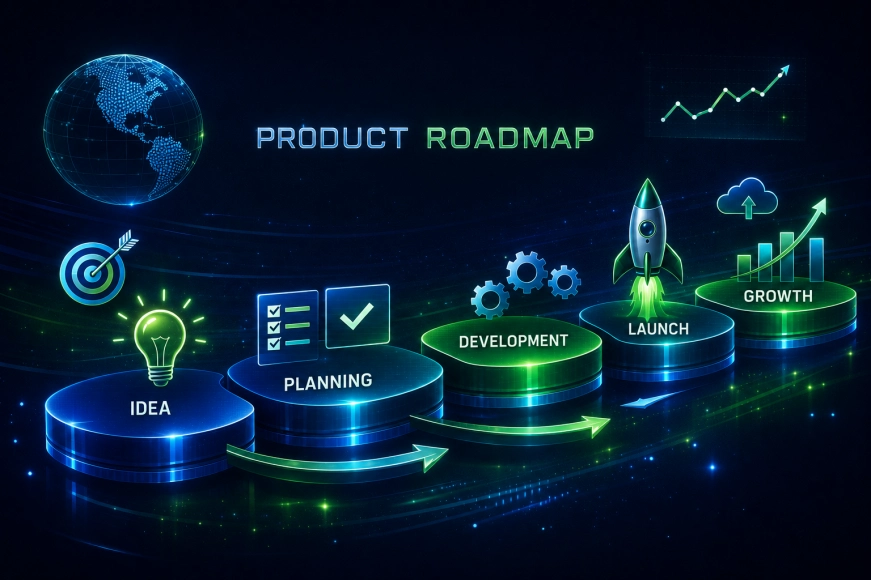
In practice, a product roadmap is a visualized development strategy broken down into stages. It does not include detailed technical implementation, but it does provide answers to key questions:
- what business goals we are addressing;
- which user problems are prioritized;
- what major initiatives or work blocks are planned;
- in what order and why.
It is important to understand: the roadmap is a living document. It is not created "once and for all". A good roadmap is regularly reviewed as new data, market changes, and results from previous stages emerge.
The difference between a roadmap and a backlog and a "checkbox" roadmap
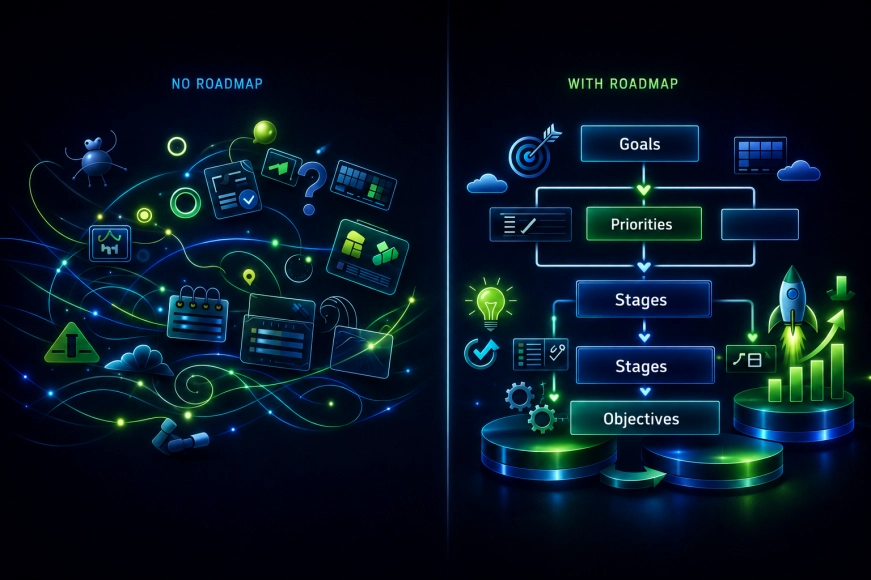
A common mistake is to confuse the roadmap with the backlog or to turn it into a formal presentation document.
The backlog answers the question «what to do», the roadmap answers «why and where we are going».
A roadmap "for show" looks nice but is not used in real work and does not influence decisions.
A good roadmap:
- helps prioritize;
- simplifies communication with the client;
- reduces the number of conflicts over deadlines and scope;
- serves as a guide for the entire team.
How to start building a product roadmap
Work on the roadmap begins not with functions and technologies, but with context.
1. Business Goals
What metrics need to change? Revenue growth, user retention, entering a new market, reducing operational costs — without a clear understanding of the goals, the roadmap loses its meaning.
2. User Value
What user problems are truly important right now? What scenarios hinder product growth?
3. Constraints
Deadlines, budget, team, technical debt, dependencies on external systems — all of this should be considered at the start, not "in the process".
Product Roadmap Structure
The structure of a roadmap can vary, but in mature products, the following levels are most commonly used:
- Goals — why we are doing this;
- Initiatives — major directions or hypotheses;
- Stages — logical sequence of development;
- Expected Effect — what should change.
Important: the roadmap does not have to be tied to specific dates down to the day. Time horizons such as quarter, half-year, or stage are more commonly used.
Table 1. Example of Product Roadmap Structure
|
Level |
What it describes |
Example |
|
Goal |
Business Outcome |
Increase Conversion |
|
Initiative |
Direction |
Improvement of onboarding |
|
Stage |
Development logic |
New registration scenario |
|
Metric |
Success criterion |
+15% completed registrations |
Prioritization: the most challenging stage
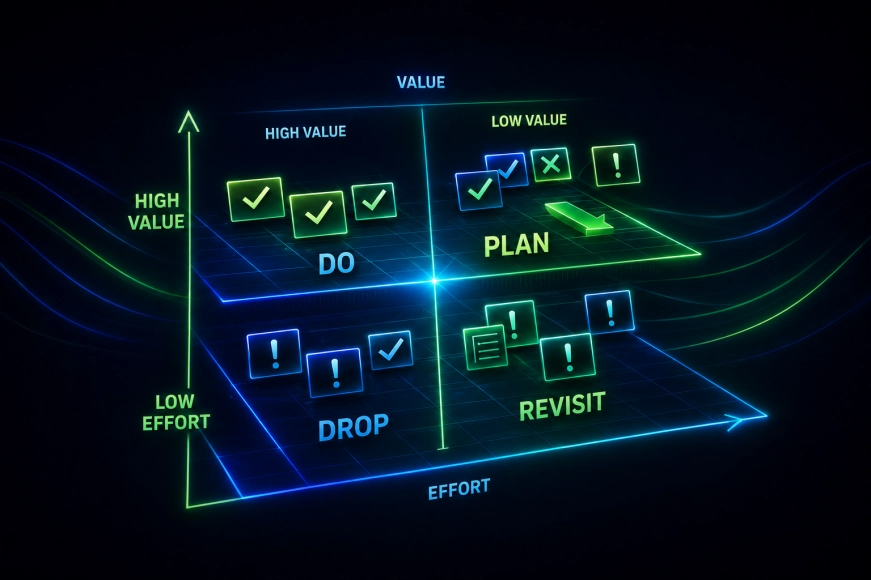
The most painful part of building a roadmap — prioritization. There are almost always more tasks than resources.
Different approaches are used for prioritization:
- value vs effort,
- impact / confidence / ease,
- business criticality,
- risks.
The key point is priorities must be transparent. If the team and the client understand why a task is more important than another, there are fewer conflicts.
How a roadmap helps manage client expectations
One of the main values of a roadmap is communication. It allows discussing not «when will this button be ready», but what result we want to achieve at this stage.
The client sees:
- the overall picture;
- the logic of development;
- the reasons for task rejection or postponement;
- the interconnection between decisions.
In practice, this reduces the number of urgent edits and "let's urgently add more".
Typical mistakes when building a roadmap
Even experienced teams make mistakes:
- Too detailed a map
Turns the document into an unsupported plan. - Ignoring technical limitations
Leads to missed deadlines and disappointment. - Lack of metrics
It's unclear whether the stage was successful. - Fixing the map «forever»
The market and product change, the map must change too.
Table 2. Errors and Consequences
|
Error |
What it leads to |
|
No prioritization |
Conflicts and chaos |
|
No metrics |
Illusion of progress |
|
No connection to the business |
Useless features |
|
No reviews |
Outdated solutions |
The role of the team in working with the roadmap
The roadmap is not a document created by the product manager "alone". In mature teams, it is formed collaboratively: analysts, designers, developers, and managers contribute.
In our practice (including in the projects of the RUSO team), collaborative work on the roadmap allows us to identify risks in advance and find more sustainable solutions.
When the roadmap needs to be revised
A good guideline is to revise the map:
- after completing a major phase;
- when business goals change;
- when new user data emerges;
- when there are significant technical limitations.
Regular revision is a sign of a mature product approach, not instability.
Conclusions
Building a product roadmap is not a formality or a presentation for investors. It is a working tool that helps the product develop consciously, and the team make coordinated decisions.
A good roadmap:
- links business and development;
- reduces chaos and the number of reworks;
- simplifies communication;
- makes product development predictable.
That is why, in long-term digital products, the roadmap becomes one of the key elements of management.