


Why push notifications have stopped being a «marketing button»
Push notifications have long ceased to be a simple tool for reminders or promotions. In 2026, this is a full-fledged product and communication channel that directly impacts retention, LTV, and brand perception.
The user today:
- receives dozens of notifications a day;
- quickly disables annoying channels;
- expects relevance and context;
- perceives push as a continuation of the user experience, not as advertising.
Therefore, a modern push strategy is not a question of «when to send», but a question of why, to whom, and in what context.
In this article, we will discuss:
- which push strategies work in 2026;
- why mass mailings are no longer effective;
- how to integrate push notifications into the product logic of a mobile application.
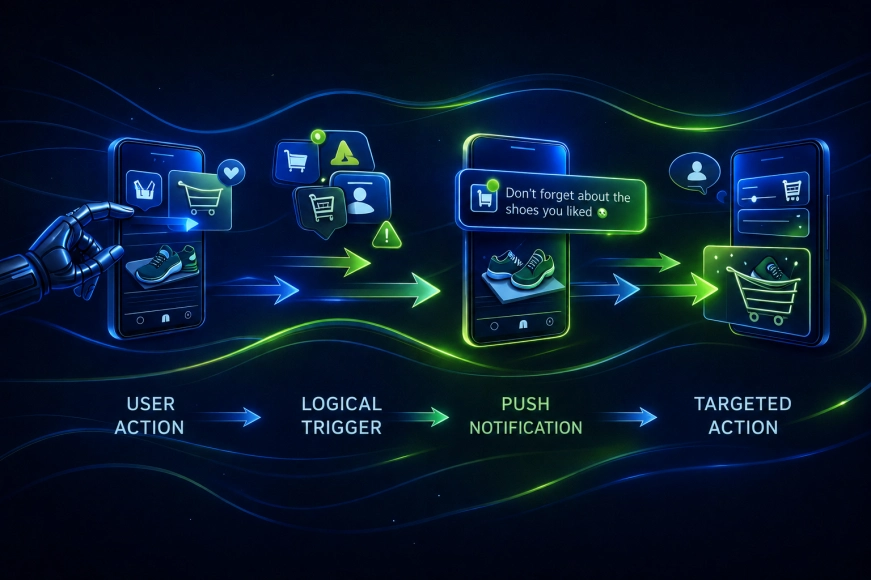
What is a push strategy really
A push strategy is a system of rules, scenarios, and data that defines:
- when to send a notification,
- to whom exactly,
- with what message,
- in what context of the user journey.
It is important to understand: push notifications do not exist separately from the product. They only work when they enhance the user scenario, not interrupt it.
Why mass push notifications no longer work
To this day, many applications use push notifications based on the principle:
«Let's send it to everyone — someone will click»
In 2026, this approach leads to:
- mass unsubscribes;
- disabling notifications;
- decline in trust in the application;
- decrease in long-term retention.
The problem is not with push notifications as a tool, but with the lack of strategy and segmentation.
Key types of push notifications in 2026
1. Transactional push notifications
This is the basic, yet most important type:
- order status;
- action confirmation;
- changes in delivery;
- system notifications.
Such push notifications:
- expected by the user;
- have a high open rate;
- build trust in the app.
The mistake is to mix transactional and marketing notifications into one stream.
2. Scenario (behavioral) push notifications
One of the most effective types of push notifications.
They are sent:
- in response to a specific user action;
- in an unfinished scenario;
- at the moment when the push logically continues the user's journey.
Examples:
- abandoned cart;
- incomplete registration;
- reminder about saved product;
- return to previously used functionality.
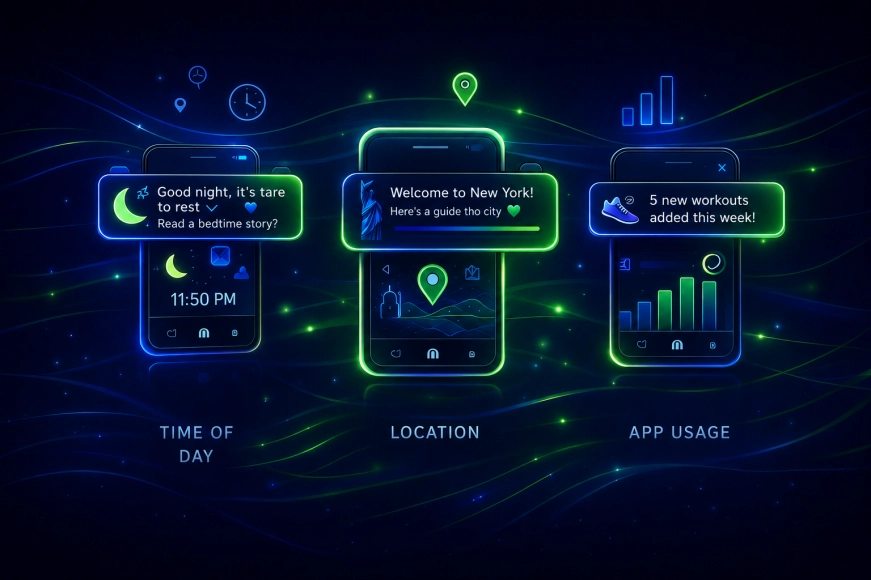
3. Contextual push notifications
Contextual push considers:
- time of day;
- geolocation (with permission);
- frequency of app usage;
- user's life cycle stage.
Such notifications are perceived not as advertising, but as timely assistance.
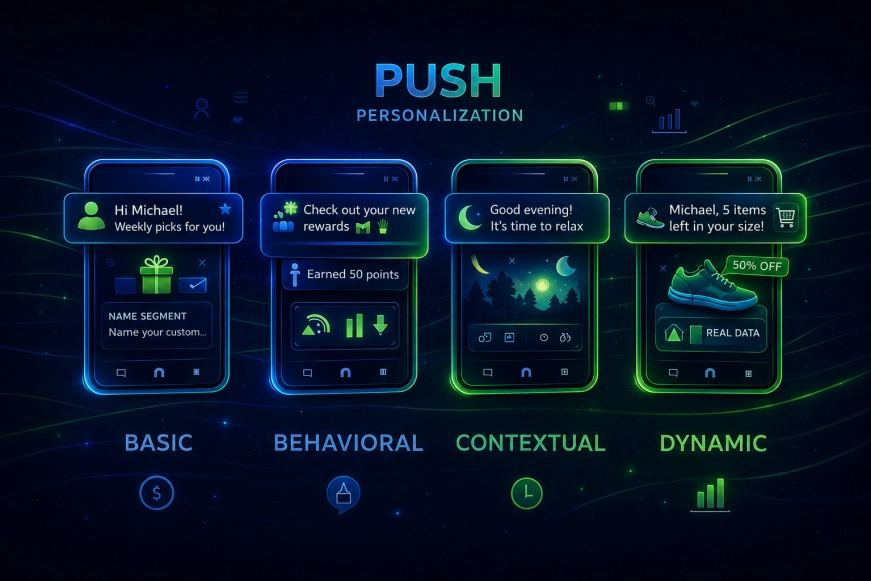
Personalization as the basis of the push strategy
In 2026, personalization is not an option, but a requirement.
Minimum level of personalization:
- username;
- action history;
- preferences;
- segment.
Advanced level:
- dynamic content;
- personal offers;
- real-time behavior adaptation.
Push without personalization is almost always perceived as noise.
Table 1. Levels of personalization of push notifications
|
Level |
What is used |
Effect |
|
Basic |
Name, segment |
Moderate |
|
Behavioral |
Action history |
High |
|
Contextual |
Time, scenario |
Very high |
|
Dynamic |
Real data |
Maximum |
Frequency and timing: less — means better
One of the most common mistakes — overestimating the acceptable frequency of push notifications.
Mature push strategy:
- limits the number of notifications;
- takes into account user reaction;
- reduces frequency in the absence of response;
- gives the user control over settings.
In 2026, respect for user attention directly affects retention.
Push notifications and product analytics
Push strategy is impossible without analytics.
It is important to measure:
- open rate;
- CTR;
- impact on the target action;
- long-term effect on retention;
- unsubscribes and disconnections.
A push notification is considered successful not when it is clicked, but when it helped the user complete the target scenario.
Table 2. Metrics for the effectiveness of push notifications
|
Metric |
What it shows |
|
Open rate |
Relevance |
|
CTR |
Message value |
|
Conversion |
Business effect |
|
Retention |
Long-term impact |
|
Opt-out rate |
Channel overload |
Integration of push strategy into the product
Push notifications should not exist separately from the product and marketing.
A mature approach includes:
- linking push scenarios to the product roadmap;
- involvement of UX designers in text creation;
- collaboration between product and marketing teams;
- a unified tone of communication.
Our team in mobile projects considers the push strategy as part of product design, not as a tool for sending messages.
Typical mistakes in push strategies
- Mass mailings without segmentation
- Identical texts for all scenarios
- Ignoring user context
- Too high frequency
- Lack of analytics and testing
How to approach push strategy systematically
A systematic approach includes:
- audit of current push notifications;
- user segmentation;
- scenario design;
- A/B testing of messages;
- regular optimization.
Push strategy — is a not a one-time setup, but a living process.
Conclusions
Push notifications in 2026 will be:
- a retention channel, not spam;
- part of the user experience;
- a tool for product growth.
Mobile applications that win are those that:
- respect user attention;
- work with context and data;
- integrate push into product logic;
- measure real impact, not clicks.