


Why the ROI of a mobile application is not about «will the development pay off?»
When a business considers a mobile application, the first question almost always sounds the same: «Will it pay off?»
But in reality, the ROI of a mobile application is not just a comparison of development costs and direct income. It is about assessing the strategic impact that the application has on sales, loyalty, operational processes, and business scalability.

In 2026, a mobile application rarely exists on its own. More often, it is:
- an additional sales channel,
- a customer retention tool,
- a data collection point,
- an element of the product ecosystem.
Therefore, calculating the ROI of a mobile application should be broader than «revenue minus costs».

What is the ROI of a mobile application
ROI (Return on Investment) — is a metric that shows how much the investments in the application yield business results.
In its classic form, the formula looks like this:
ROI = (Profit Obtained − Investments) / Investments × 100%
However, in the case of mobile applications, «profit» is not always expressed directly in money. Part of the effect may be:
- indirect,
- deferred,
- distributed through other channels.
And this is where most companies make mistakes.
What types of ROI are there for mobile applications
1. Direct financial ROI
The most obvious option:
- paid subscriptions,
- in-app purchases,
- transaction fees.
Such ROI is easier to calculate, but it is not characteristic of all applications.
2. Indirect commercial ROI
The mobile application enhances other channels:
- increases purchase frequency,
- raises the average check,
- reduces customer churn,
- stimulates repeat sales.
For example, a user with the app installed buys more often than a user of just the web version.
3. Operational ROI
The application reduces business costs:
- process automation,
- reducing support load,
- reduction of manual labor,
- decrease in the number of errors.
This type of ROI is often underestimated, although it can provide the greatest effect.
Table 1. Types of Mobile App ROI
|
Type of ROI |
What it is formed by |
When it is relevant |
|
Direct |
Paid features |
Digital products |
|
Indirect |
Sales growth |
E-commerce, services |
|
Operational |
Cost reduction |
B2B, internal apps |
Why calculating the ROI of a mobile app is difficult
The complexity of calculating ROI is related to several factors:
- the effect is distributed over time;
- part of the value is expressed not directly in money;
- the application affects other channels;
- the metrics change as the product grows.
The mistake — trying to get an exact ROI before the launch. It is much more effective to build a calculation model and gradually refine it based on data.

What metrics to use for calculating ROI
To correctly calculate the ROI of a mobile application, it is important to define a set of metrics in advance.
Key metrics:
- CAC (customer acquisition cost);
- LTV (lifetime value);
- Retention;
- ARPU / ARPPU;
- Cost per install;
- Cost per transaction;
- Cost of supporting and developing the application.
Important: consider not only development, but also support, marketing, analytics, infrastructure.
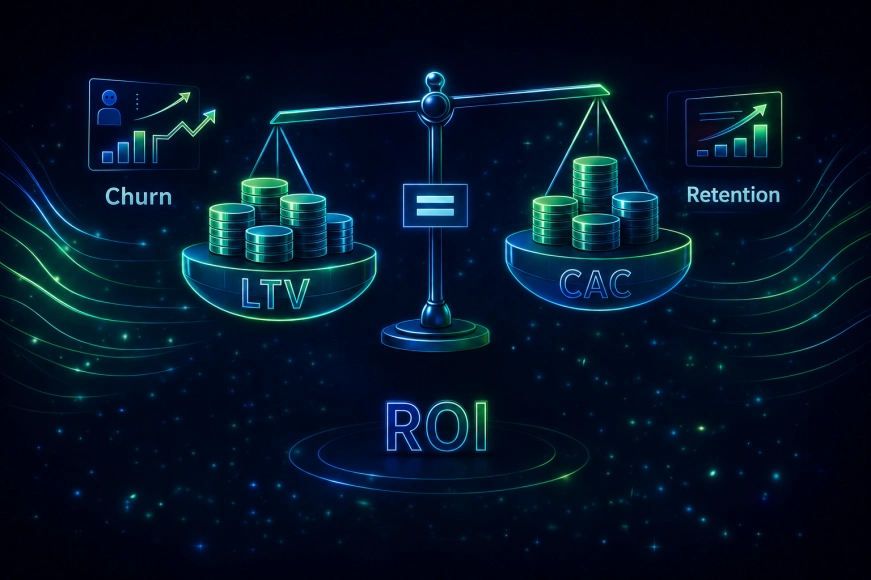
The relationship between ROI and unit economics
The ROI of a mobile application is directly related to unit economics.
If one user is unprofitable, the overall ROI will not become positive when scaling.
Our team in product projects always first checks the unit economics, and only then calculates the ROI at the application level.
Table 2. Unit Economics and ROI
|
Indicator |
Impact on ROI |
|
LTV > CAC |
Positive |
|
High churn |
Negative |
|
Growth of retention |
Enhances ROI |
|
Cost reduction |
Increases ROI |
When the mobile app starts to pay off
In most cases, a mobile app does not become profitable immediately. Typical scenarios:
- first months — investment phase;
- 6–12 months — stabilization of metrics;
- further — increase in efficiency and ROI.
The mistake — closing the project too early, without allowing it to reach a plateau.
How to Increase Mobile App ROI
Practical levers for increasing ROI:
- improving UX and use cases;
- personalization;
- spam-free push strategies;
- onboarding optimization;
- focusing on retention, not just installs;
- reducing support costs through architecture and automation.
The RUSO team in such projects always looks at ROI as a result of comprehensive product solutions, not just a single change.
Typical mistakes in calculating ROI
- Counting only the development cost
- Ignoring indirect effects
- Expecting instant payback
- Not considering the increase in operating costs
- Not revising the model as the product grows
Conclusions
The ROI of a mobile application is an indicator of product maturity. It requires:
- data,
- time,
- correct methodology,
- understanding the role of the application in the business.
Companies that consciously consider ROI make more informed decisions about development, scaling, and investments in mobile products.