


Web Development in 2026: Engineering Maturity, Architecture, and AI as a Working Tool
By 2026, web development will have completely transcended the set of technologies, frameworks, and libraries. The market enters a phase of engineering maturity, where architectural solutions, process manageability, product resilience, and their ability to evolve without explosive cost growth become key.
Artificial intelligence occupies a special place in this transformation. In 2026, AI ceases to be an experiment or a "nice-to-have feature" and becomes a full-fledged tool for web development. However, its role fundamentally changes: AI does not replace specialists but enhances teams that already possess architectural thinking and engineering expertise.
That is why web development trends in 2026 are formed not around specific technologies but around a systemic approach: architecture, processes, performance, and the conscious application of AI.
Growing user and business demands
The modern user does not analyze what stack the product is built on. They expect the web service to be fast, stable, and understandable in any situation. In 2026, this is not a competitive advantage, but a minimum standard.
Key user expectations:
- instant interface response;
- stable operation under load;
- absence of critical errors;
- logical user scenarios;
- personalization and adaptation to context.
From the business side, the requirements are even higher. The web product becomes the central digital platform of the company: sales, communications, analytics, and integrations with internal systems all go through it. Errors in architecture or processes directly affect financial indicators.
AI further raises the bar of expectations. Users quickly get used to intelligent recommendations, automated support, and personalized interfaces. This requires web development not only to provide quality UX but also to ensure that the architecture is ready to work with data, models, and computational load.
Technical debt as a managed risk, not an inevitable evil
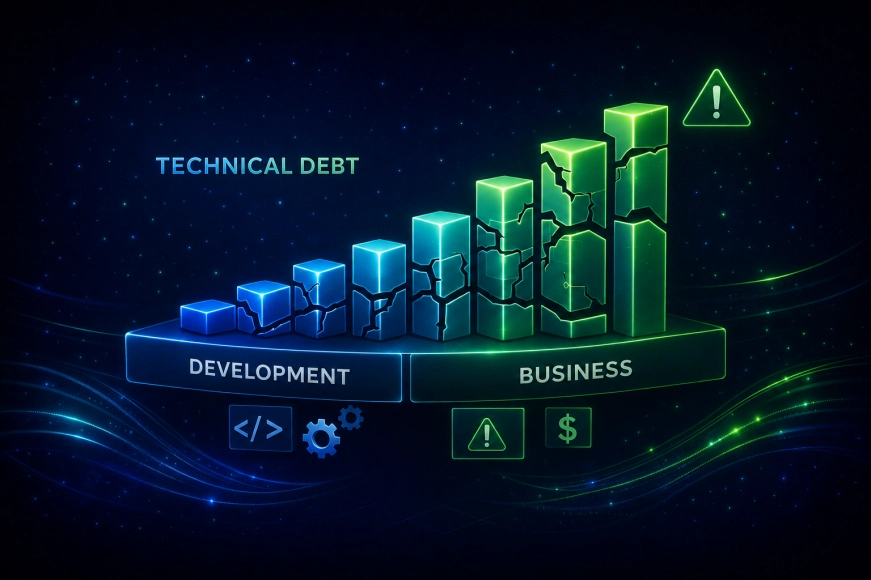
Technical debt — one of the key factors determining the fate of the web product in 2026. Unlike in previous years, it is no longer perceived as an internal development issue. Today, it is a direct business risk.
Projects with uncontrolled technical debt face:
- delay in the release of new features;
- increase in the number of errors and incidents;
- complication of team support and onboarding;
- unpredictable cost of development.
AI amplifies this effect. Automatic code generation and quick solutions without architectural context can speed up the start, but in the absence of engineering control, they lead to accelerated accumulation of technical debt.
Technical debt: impact on product and business
|
Level of technical debt |
Impact on Development |
Impact on Business |
|
Low |
Fast and Stable Releases |
Product Growth |
|
Medium |
Slowdown in Development |
Increase in Operating Costs |
|
High |
Frequent bugs and regressions |
Loss of user trust |
|
Critical |
Need for rewriting |
Direct financial risks |
Our team and the RUSO team as a whole view technical debt as a manageable process: it is measured, planned, and taken into account when making architectural decisions, especially with the active use of AI.
Web application architecture as a strategic asset
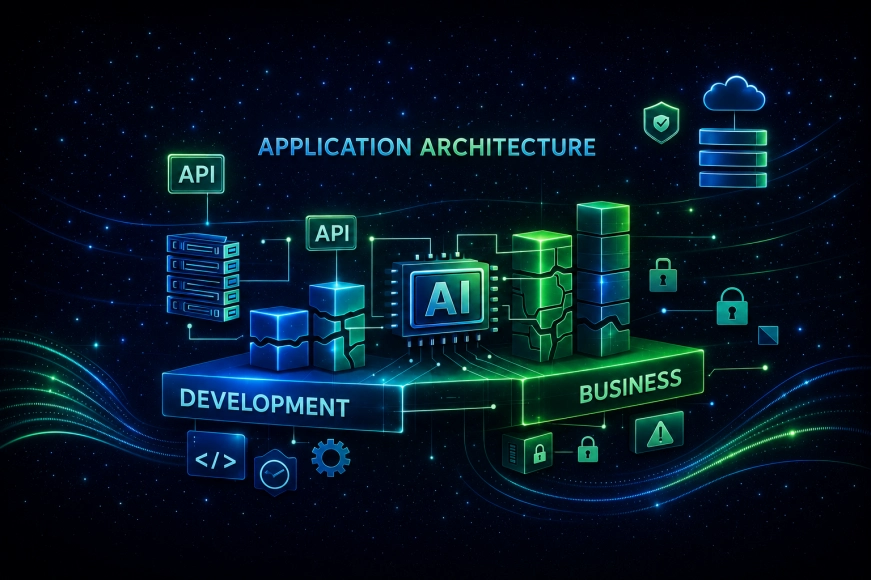
One of the most sustainable trends in web development for 2026 is the return of architecture to the center of attention. Modern web applications are no longer designed "around the framework." The foundation lies in architectural principles:
- API-first;
- modularity and loose coupling;
- separation of concerns;
- scalability and fault tolerance.
Well-structured web application architecture allows:
- to develop the product without rewriting the core;
- to onboard new teams and services;
- to integrate AI components without chaos;
- reduce the cost of changes over distance.
In 2026, AI is increasingly seen as an integral part of architecture, rather than an external addition. This requires well-thought-out work with data, APIs, and infrastructure.
Performance and observability as a standard
The performance of web products in 2026 is not just about page load speed. It is a comprehensive measure of system quality: responsiveness, stability under load, error rates, and user behavior.
With the increasing complexity of systems and the implementation of AI, the importance of observability grows. Modern web products must be observable:
- centralized logging;
- collection of technical and product metrics;
- tracing requests;
- analytics of user scenarios.
Without observability, AI functionality becomes a «black box» that cannot be managed.
CI/CD pipeline and development automation
In 2026, CI/CD pipeline will be the basic standard of mature engineering culture. Manual releases and lack of automation are perceived as signs of immature processes.
CI/CD allows:
- accelerate the release of updates;
- reduce the impact of the human factor;
- ensure the stability of environments;
- scale the team without losing quality.
AI is increasingly integrated into CI/CD: code analysis, vulnerability detection, assistance in testing. However, the control of specialists remains key. AI complements processes but does not replace the engineering expertise of the RUSO team and our team as a whole.
Artificial Intelligence as a Multiplier of Team Maturity
AI — one of the most discussed trends in web development 2026, but also one of the most misinterpreted. It is not a universal solution and does not reduce the requirements for architecture and processes.
AI works effectively where:
- there is a well-thought-out architecture;
- development processes are established;
- technical debt is monitored;
- there are experienced specialists.
In weak systems, AI accelerates the accumulation of problems. In mature products, it reduces routine, improves decision quality, and speeds up development.
Product approach and business value of technologies
Modern web development is definitively shifting from project thinking to product thinking. Launching a website or application is the beginning of the life cycle, not the final point.
In 2026, technologies will be evaluated through the prism of business value:
- ROI;
- total cost of ownership;
- impact on development speed;
- support and scaling risks.
Evolution of web development approaches
|
Criterion |
2020–2022 |
2026 |
|
Approach |
Project |
Product |
|
Focus |
Implementation |
Development and Scaling |
|
Architecture |
Secondary |
Strategic Asset |
|
AI |
Experiments |
Working Tool |
|
Technical Debt |
Ignored |
Managed |
Conclusions
Web Development Trends 2026 — are maturity trends. Architecture, manageability, performance, automation, and conscious use of AI form the foundation of modern web products.
AI does not negate the role of specialists. On the contrary, it makes engineering expertise even more significant. Companies that are already building architecture and processes with these factors in mind today are gaining sustainable products ready for market growth and changes.