


Why digital products do not scale without unit economics
Many digital products appear successful at the idea, design, and even user growth levels, but fail to achieve sustainable profit for years. The reason is often not in technology or marketing, but in the lack of understanding of unit economics.
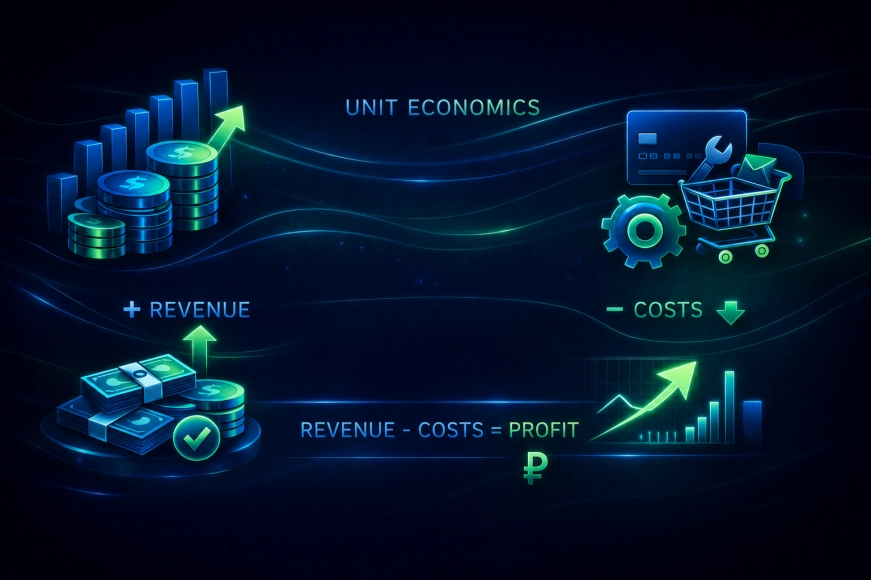
Unit economics is a way to look at a product not "as a whole," but through the lens of one unit of value: one user, one order, one subscription. It answers a simple yet critical question: does the product make money on each unit or lose money.
By 2026, unit economics became a fundamental tool for managing digital products—from startups to mature platforms. Without it, making informed decisions about development, scaling, and investments is impossible.
What is unit economics in simple terms
Unit economics is a model that shows:
- how much it costs to acquire one unit (user, client);
- how much revenue it brings over its lifetime;
- what margin remains after all variable costs.
The key idea is simple:
if one unit is unprofitable — scaling only increases the losses.
What is considered a "unit" in digital products
A unit depends on the product's business model:
- SaaS — one paying user or account
- Marketplace — one transaction or active user
- E-commerce — one order
- Mobile application — one active user
- B2B platform — one client or contract
Error — choose the unit «for convenience». It should reflect the main source of income.
Basic indicators of unit economics
Despite the variety of products, key metrics are almost always the same:
- CAC (Customer Acquisition Cost) — cost of acquisition
- LTV (Lifetime Value) — revenue over the lifetime
- ARPU / ARPPU — average revenue
- Churn — attrition
- Contribution Margin — margin per unit
Important: you need to count variables, not all expenses.
|
Metric |
What it shows |
Why it is needed |
|
CAC |
Customer Acquisition Cost |
Marketing Control |
|
LTV |
Revenue per Unit |
Understanding Value |
|
ARPU |
Average Revenue |
Comparison of segments |
|
Churn |
Losses |
Growth forecast |
|
Margin |
Profitability |
Scaling decisions |
Why growth without unit economics is a dangerous illusion
User growth alone does not mean success. A common situation:
- traffic is increasing,
- the number of users is increasing,
- expenses are rising,
- profit is not appearing.
Without unit economics, it is impossible to answer:
- whether it is worth scaling;
- which acquisition channels work;
- which user segments are unprofitable;
- where the business model is "leaking".
Our team regularly encounters products where growth conceals fundamental problems in the model.

Unit economics and product life cycle stages
It is important to understand: unit economics changes over time.
- At the MVP stage, a negative margin is acceptable
- At the product-market fit stage, metrics stabilize
- At the scaling stage, the unit must be sustainably positive
The mistake is to demand perfect unit economics too early or, conversely, to ignore it for too long.

Common mistakes in calculating unit economics
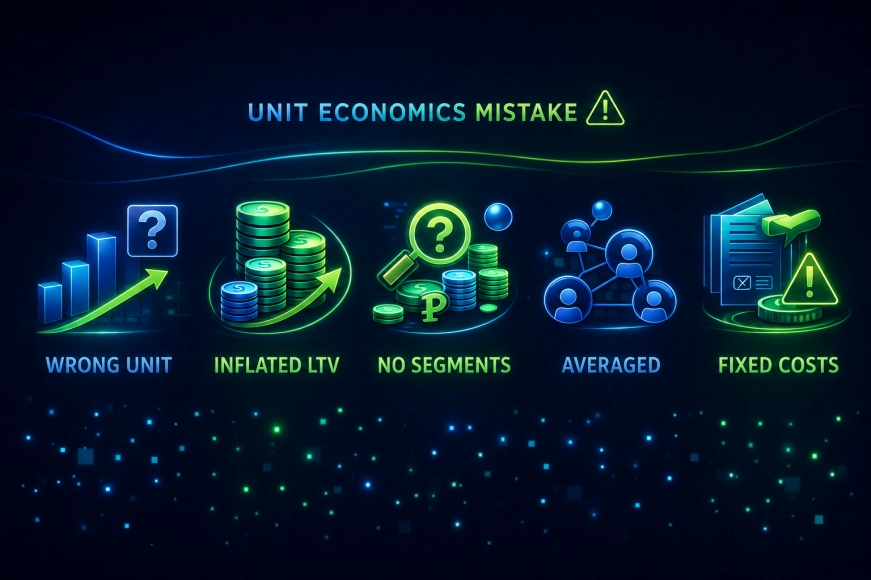
- Mixing variable and fixed costs
- Averaging all users into one unit
- Ignoring churn
- Inflated LTV without verified data
- Lack of segmentation
|
Error |
What it leads to |
|
Invalid unit |
Model distortion |
|
Overestimated LTV |
Investment errors |
|
No segmentation |
Unprofitable growth |
|
No review |
Loss of control |
How to use unit economics in product management
Unit economics — not a report for investors, but a working tool:
- for prioritizing features;
- for selecting marketing channels;
- for determining the pricing model;
- for managing the product roadmap.
In mature teams, unit economics indicators influence product decisions as strongly as UX research or user behavior analytics.
Unit economics and technical solutions
Technical solutions directly affect unit economics:
- architecture affects support costs;
- performance — on infrastructure costs;
- automation — on operational expenses.
The RUSO team in product projects always considers the impact of technical solutions on the product's economy, not just on the speed of development.
When and how to review unit economics
Unit economics should be reviewed:
- when changing the business model;
- when entering new markets;
- when changing the channels of attraction;
- when the team and infrastructure grow.
This is not a one-time task, but part of regular product management.
Conclusions
Unit economics of digital products is the foundation of conscious growth. It helps:
- see the real picture of the business;
- make decisions based on data, not intuition;
- scale without losing control;
- timely identify weaknesses in the model.
Products that understand their unit economics survive and grow. The others — simply become more expensive to support.