


Why UX research is important for business, not just for designers
UX research is often perceived as an additional stage that can be shortened or completely skipped for the sake of speed. In practice, this approach most often leads to a loss of conversion, an increase in development costs, and the need to redo the product after launch.
In digital products of 2026, user experience directly affects business metrics: sales, retention, LTV, repeat visits. UX research allows decisions to be made based not on assumptions, but on data — user behavior, their goals, and real scenarios of product use.
It is important to understand: UX research is not abstract analytics and not "surveys for the sake of a report." It is a practical tool that reduces risks and increases product efficiency.

What tasks do UX research solve
UX research answers key questions that cannot be addressed solely through analytics or design experience:
- why users do not reach the target action;
- where exactly frustration arises;
- which product usage scenarios were not considered;
- which features hold no value for the user;
- what hinders conversion and repeat actions.
In practice, UX research allows:
- to optimize user scenarios;
- to shorten the path to the target action;
- reduce the number of errors and support requests;
- increase conversion without increasing advertising budgets.
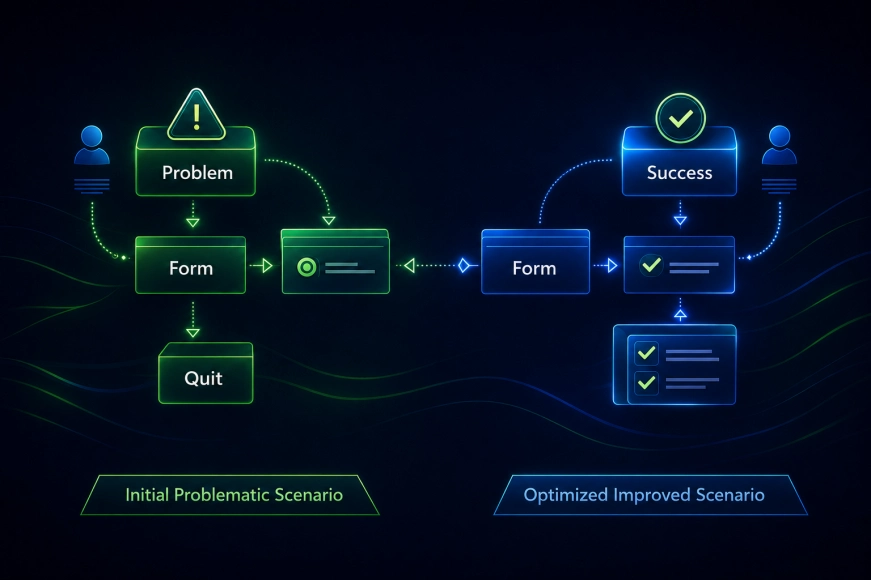
Case 1. Online service: conversion growth without redesign
In one of the projects, the team faced a typical situation: traffic was growing, but conversion remained at the same level. Analytics showed a high bounce rate at the form filling stage.
The UX research included:
- analysis of user sessions;
- in-depth interviews;
- usability testing of key scenarios.
The result turned out to be non-trivial: the problem was not in the form design, but in the wording and logic of the steps. Users did not understand why part of the data was required and were hesitant to continue.
After adjusting the text, the order of fields, and adding contextual hints, the conversion increased without a visual redesign of the interface.
Case 2. B2B Product: Reducing Support Load
In B2B systems, UX errors often manifest not in refusals but in an increase in support requests. Users are formally "using" the product but face difficulties in completing tasks.
The UX research in this case included:
- contextual observation;
- analysis of support requests;
- interface testing with real users.
It turned out that the interface required users to have knowledge of the internal logic of the system. After revising the navigation and scenarios, the number of support requests decreased, and the time to complete standard operations was reduced.
When UX research is especially critical
UX research is essential in projects:
- with a long life cycle;
- with high development costs;
- in B2B products;
- in e-commerce and services with high competition;
- when launching new features.
Table 1. When UX Research Provides Maximum Impact
|
Project Type |
Risk Without Research |
Effect of UX Research |
|
Startup / MVP |
Incorrect Hypotheses |
Quick Idea Validation |
|
B2B System |
Increase in support load |
Reduction in operational costs |
|
E-commerce |
Loss of conversion |
Increase in sales |
|
SaaS |
Low retention |
Increase in LTV |
|
Corporate portals |
User resistance |
Increasing Engagement |
UX Research Methods: What Works in 2026
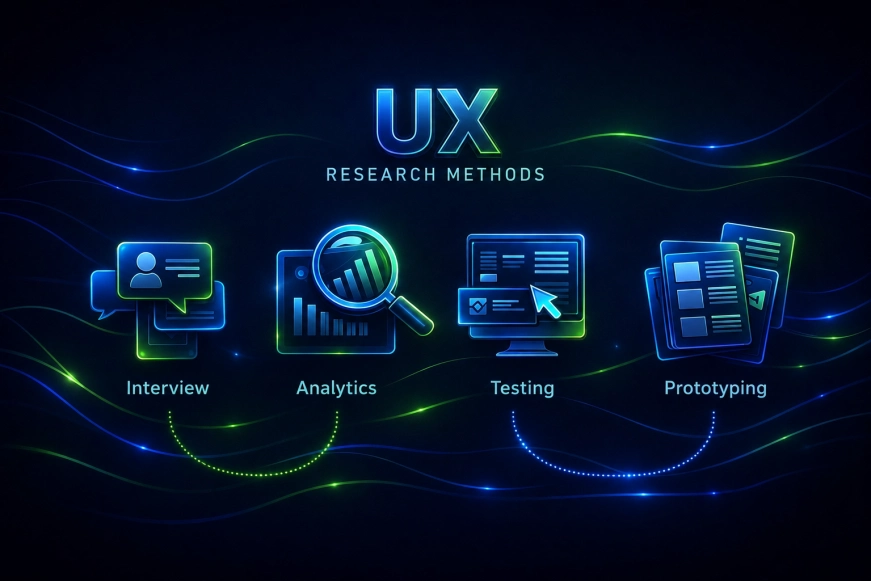
In 2026, UX research rarely relies on a single method. A combined approach is the most effective:
- quantitative analytics (metrics, events, funnels);
- qualitative interviews;
- usability testing;
- user scenario analysis;
- prototype testing.
The choice of methods depends on the product stage, research goals, and available resources.

UX Research and Conversion Growth
One of the key misconceptions is to think that UX research is only needed to improve the interface. In practice, it directly impacts commercial performance.
UX research helps:
- identify real barriers to purchase;
- remove unnecessary steps;
- adapt the product to audience expectations;
- increase user trust.
Table 2. Relationship Between UX Issues and Business Metrics
|
UX Problem |
Impact on User |
Impact on Business |
|
Complex Navigation |
Loss of Orientation |
Decrease in Conversion |
|
Unobvious Scenarios |
Errors |
Increase in refusals |
|
Overloaded forms |
Fatigue |
Loss of leads |
|
Lack of feedback |
Distrust |
Decline in sales |
Errors in conducting UX research
Often, UX research does not yield results due to errors in the approach:
- research is conducted formally;
- findings are not implemented in the product;
- non-target users are studied;
- data is interpreted without business context.
UX research works only when it is integrated into the development and decision-making process.
In 2026, UX research is not a one-time event, but a continuous process. Products evolve, audiences change, and usage scenarios become more complex. Without regular hypothesis testing, a product begins to lose effectiveness.
Conclusions
UX research is a tool for managing risks and product growth. Real cases show that even small data-driven changes can significantly impact conversion, retention, and user satisfaction.
Companies that systematically use UX research gain a competitive advantage through more accurate decisions and a better understanding of their audience.