


Why UX Directly Affects Conversion
In 2026, UX stopped being about «convenience». Today, user experience is one of the key factors influencing the conversion of digital products. Websites and applications compete not only on functionality but also on decision-making speed, trust level, and cognitive simplicity.
The modern user does not study the interface — they scan, compare, and make decisions in seconds. Any extra load, non-obvious action, or visual noise directly reduces conversion. That is why UX techniques in 2026 are viewed as a tool for business growth, rather than a decorative layer over design.

Conversion Starts with Clarity, Not Creativity
One of the key mistakes is trying to increase conversion through visual effects. In practice, the opposite works: the simpler and clearer the interface, the higher the likelihood of the target action.
Conversion-focused UX design answers three questions:
- What should the user do?
- Why should they do it here and now?
- What will happen after the action?
If there is no immediate answer to at least one question — conversion drops.
Hierarchy and Focus of Attention
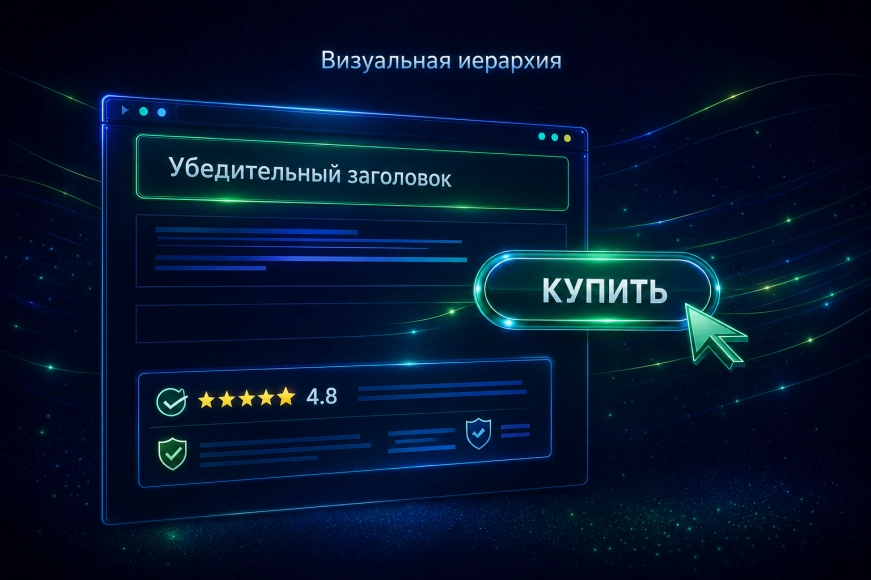
The correct visual hierarchy is a fundamental UX technique that directly affects conversion. The user always sees the interface not as a whole, but in fragments. The task of design is to manage this attention.
Key elements:
- main CTA,
- value proposition,
- confirmation of trust.
Everything else should either support these elements or take a backseat.
Minimizing cognitive load
The more decisions a user has to make, the less likely they are to reach the end. One of the strongest UX techniques for increasing conversion is reducing the number of choices.
This is achieved by:
- reducing fields in forms,
- combining steps,
- logical default values,
- clear prompts.
Table 1. The impact of cognitive load on conversion
|
UX factor |
High load |
Optimized UX |
|
Number of fields |
8–10 |
3–5 |
|
Number of steps |
4–5 |
1–2 |
|
Explanations |
None |
Built-in |
|
Conversion |
Low |
Higher by 20–40% |
Trust as a UX Element
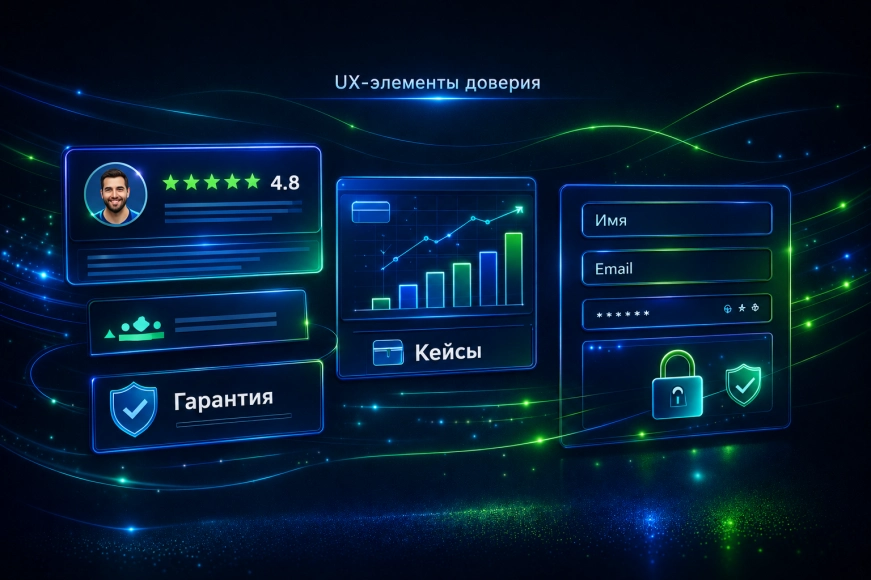
A user does not take a targeted action if they do not trust the product. In 2026, trust is formed not by texts like "we are reliable," but through UX details:
- clear structure,
- predictable interface behavior,
- neat typography,
- absence of aggressive patterns.
Trust is a feeling of control. If the user understands what is happening and why, they are more willing to act.
Microinteractions and Feedback
Microinteractions — one of the most underrated UX tools. They do not directly increase conversion, but reduce tension and confirm that the system responds to user actions.
Examples:
- button press animation,
- loading indicator,
- confirmation of successful action.
Without feedback, the user doubts, and doubt — the main enemy of conversion.
Speed and UX
Interface speed — is UX. Even the most thought-out design does not work if the user is waiting. In 2026, a delay of 1–2 seconds is perceived as an error.
UX techniques related to speed:
- skeleton screens,
- data preloading,
- visual process indicators.
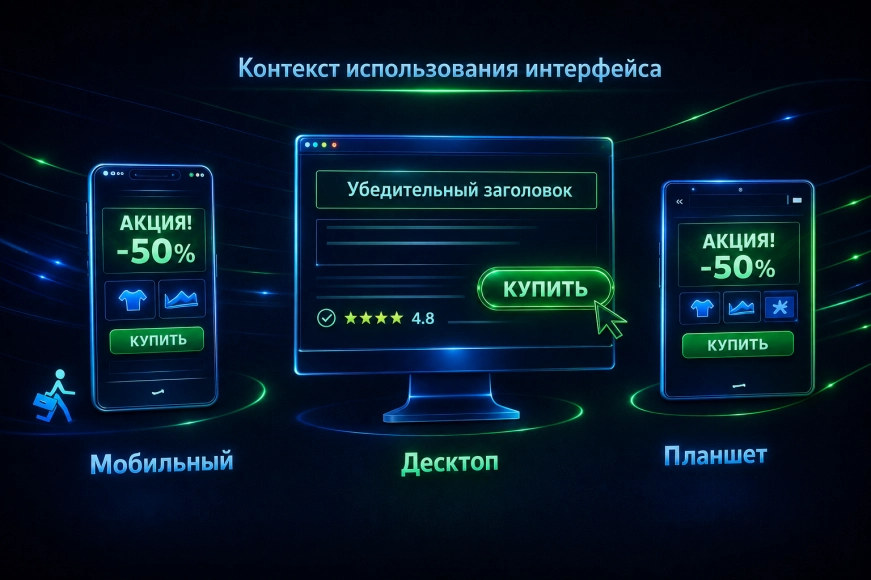
Conversion depends not only on design but also on context. The user may be on the go, at work, or at home. UX must adapt to the usage scenario.
Mobile UX in 2026 — is not a «reduced version of the site», but a separate interaction logic.
UX patterns that really increase conversion
Over the years of practice (including in projects of the RUSO team), a set of patterns has been formed that consistently work:
Table 2. UX patterns and their impact
|
UX Technique |
Effect |
|
One main CTA |
Increase in clickability |
|
Clear headline with value |
Increased engagement |
|
Short forms |
Increase in submissions |
|
Step-by-step scenarios |
Reduced drop-offs |
|
Feedback |
Increased trust |
UX — is a process, not a screen
One of the key mistakes is the attempt to "fix conversion" through redesign. In reality, UX techniques only work in conjunction with analytics, hypotheses, and testing.
UX that increases conversion is:
- behavior analysis,
- hypothesis formation,
- testing,
- iterative improvements.
Conclusions
UX techniques that increase conversion in 2026 are not a set of visual tricks, but a systematic approach to user behavior. Simplicity, clarity, trust, speed, and feedback create an experience that leads to target actions.
Companies that invest in UX as a business tool achieve sustainable conversion growth and a more loyal audience.