


Why the choice of platform is a strategic decision, not a technical formality
Choosing a CMS or platform for e-commerce is one of the key decisions that a business makes at the start or during scaling. Mistakes here rarely manifest immediately, but almost always become apparent after 6–12 months: in the form of limitations, rising costs, complex modifications, and a decline in development speed.
In 2026, the question of platform choice no longer sounds like "what can be launched faster." It sounds different:
what can the business grow, scale, and adapt without constant compromises.
In this article, we will analyze three of the most common scenarios for e-commerce:
- using 1C-Bitrix as a ready-made commercial platform;
- using free CMS (Open Source solutions);
- developing a custom (bespoke) web solution for a specific business.
Where to Start When Choosing a Platform
A common mistake is to start the selection with technologies. In practice, the correct logic is the opposite.
Before choosing a platform, it is important to answer the following questions:
- what processes are the foundation of the business;
- is scaling planned;
- which integrations are critical (1C, ERP, CRM, marketplaces);
- how often the sales logic will change;
- who and how will support the system further.
Without these answers, the choice of CMS turns into a lottery, where the consequences manifest only after the launch.
Bitrix as a platform for e-commerce
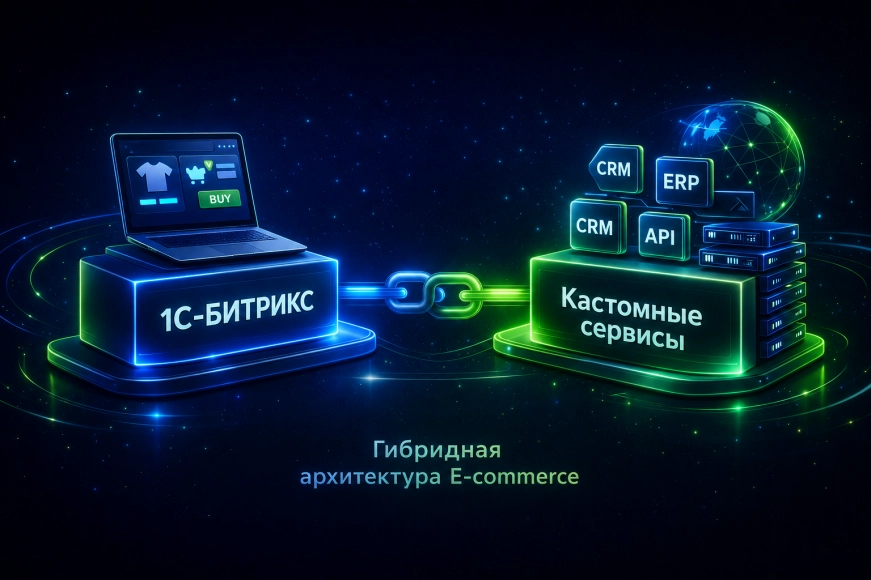
1C-Bitrix remains one of the most popular platforms for e-commerce — and this is not accidental. It covers the basic needs of an online store "out of the box" and allows for a relatively quick market entry.
When Bitrix is a justified choice
Bitrix is well-suited if:
- a quick launch is required;
- business processes are relatively standard;
- deep integration with 1C is important;
- the team has already worked with the platform;
- no complex custom logic is planned.
Strengths of Bitrix
- ready-made ecosystem;
- developed module market;
- large number of specialists;
- integrations with 1C products;
- understandable administrative part.
Limitations of Bitrix that are important to know
As the business grows, weaknesses begin to emerge:
- difficulty of support with deep customization;
- growth of technical debt;
- architectural limitations;
- dependence on licenses and updates;
- decreased flexibility in non-standard scenarios.
In many projects, Bitrix works great up to a certain scale, after which it starts to hinder development.
Table 1. Bitrix for e-commerce
|
Criterion |
Bitrix |
|
Launch Speed |
High |
|
Logic Flexibility |
Average |
|
Scalability |
Limited |
|
Integrations with 1C |
Excellent |
|
Long-term flexibility |
Average / low |
Free CMS: why it's rarely a good option for e-commerce
Free CMS (Open Source solutions) often look attractive at the start:
- no licensing costs;
- quick launch;
- a large number of plugins and templates;
- a sense of flexibility and freedom.
However, in practice, such solutions for e-commerce almost always create more problems than advantages, especially when the business starts to grow.
Main limitations of free CMS:
- Low quality control
Plugins are developed by different teams without a single standard. - Security
Vulnerabilities, outdated modules, and dependence on the community increase risks. - Weak scalability
The growth of the catalog, traffic, and logic quickly runs into architectural limitations. - Rapid growth of technical debt
The project accumulates "patches" that are difficult to maintain and develop. - False economy
The absence of a license is compensated by the increase in costs for modifications and support.
Free CMS can be suitable for small showcases or temporary solutions, but as a basis for growing e-commerce, they rarely justify themselves.
Custom solution: when a business needs control
A custom e-commerce solution is not about «writing everything from scratch for the sake of technology». It is a conscious choice in favor of control, flexibility, and long-term efficiency when a business goes beyond standard scenarios.
By a custom solution, we mean a custom web platform designed for specific processes and goals of the business.
When a custom solution is justified
- the business logic is non-standard;
- e-commerce — the core of the business;
- many complex integrations;
- active scaling is planned;
- performance and architecture are important.
In such cases, the limitations of ready-made CMS start to cost more than developing a custom solution.
Advantages of custom e-commerce
- full compliance with business processes;
- flexible architecture;
- control over data;
- high performance;
- absence of licenses and strict frameworks.
Our team in such projects considers a custom-built platform as a long-term business asset, not just an IT project.
Risks of the custom approach
- higher initial investments;
- high importance of architectural solutions;
- dependence on team expertise;
- need for systematic support.
The RUSO team in such projects always starts with architectural design to avoid accumulating technical debt.
Table 2. Comparison of Approaches
|
Criterion |
Free CMS |
Bitrix |
Custom-made |
|
Startup Costs |
Minimum |
Average |
High |
|
Flexibility |
Limited |
Average |
Maximum |
|
Scalability |
Weak |
Limited |
Planned |
|
Control over the system |
Low |
Medium |
Full |
|
Long-term value |
Often higher than expected |
Growing |
Optimizing |
How to make the right decision
The right choice of platform does not start with the question "what is cheaper", but with the question:
- where the business will be in 2–3 years;
- how important the speed of changes is;
- which processes are critical;
- who owns the system and the data.
Only after this does it make sense to choose a specific technology.
Conclusions
- Free CMS — a fast but risky path for e-commerce.
- Bitrix — a good tool for standard tasks and quick start.
- Custom solution — the choice for businesses where e-commerce is a strategic asset.
The mistake — is not in choosing a specific platform, but in choosing without understanding the consequences.